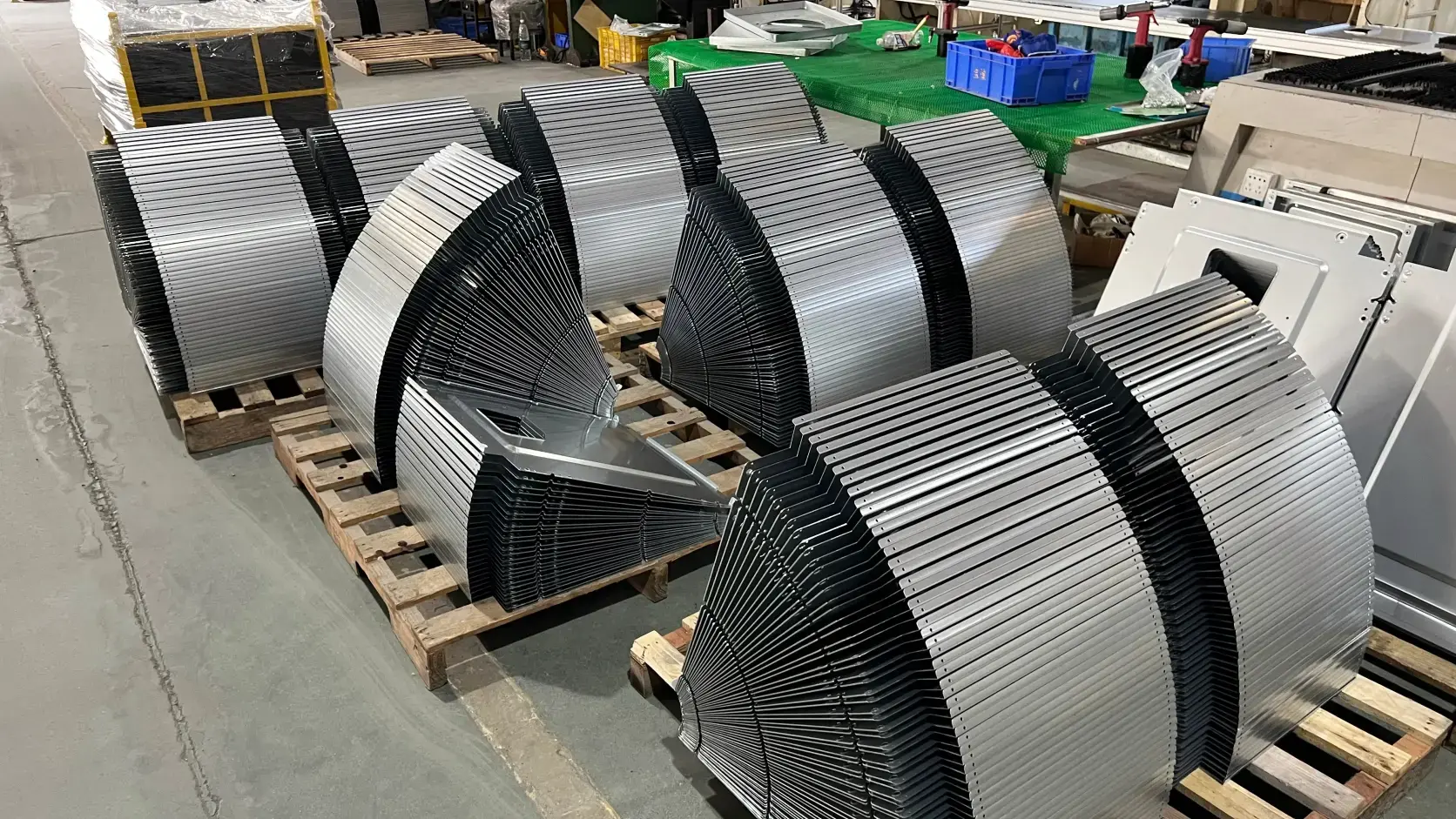

YSie haben das Design für ein Lochblechpanel fertiggestellt — Lochmuster ausgewählt, Material spezifiziert, Oberflächenfinish genehmigt. Die nächste Frage Ihres Projektmanagers ist diejenige, die darüber entscheidet, ob der restliche Zeitplan eingehalten werden kann: Wann können wir es bekommen?
Die Antwort ist keine einzelne Zahl. Die Lieferzeit für Lochbleche reicht von wenigen Tagen für Standard-Lagerplatten bis zu mehreren Wochen für kundenspezifische Aufträge, abhängig von Materialverfügbarkeit, Lochgeometrie, Produktionsmethode und Nachbearbeitungsanforderungen. Wenn Sie diese Variablen vor der Auftragserteilung verstehen, können Sie realistische Liefererwartungen setzen und kostspielige Terminüberraschungen vermeiden.
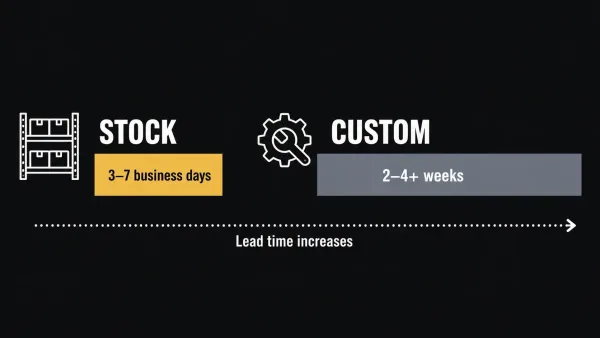
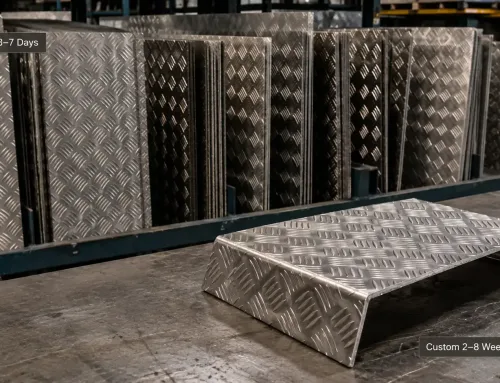
Ein visueller Vergleich der Lieferzeiten: Lager-Lochbleche werden in 3–7 Werktagen versandt, während kundenspezifische Aufträge typischerweise 2–4 Wochen oder länger benötigen.
Was die Lieferzeit für Lochbleche bestimmt
Die Lieferzeit ist kein festes Angebot des Lieferanten — sie ist die Summe mehrerer Schritte, von denen jeder seine eigene Variabilität hat. Ein typischer Auftrag für Lochbleche durchläuft Materialbeschaffung, Werkzeugrüstung, Perforation, Oberflächenbehandlung, Qualitätsprüfung und Verpackung. Jeder dieser Schritte kann zum Engpass werden.
Für Lager-Lochbleche in gängigen Materialien und Standard-Lochmustern versenden Lieferanten oft innerhalb von 3 bis 7 Werktagen. Kundenspezifische Aufträge — nicht standardmäßige Lochgrößen, Speziallegierungen oder komplexe Oberflächenfinishes — erfordern typischerweise 2 bis 4 Wochen, und manchmal länger für dicke Platten oder hochdichte Lochmuster.
Die folgenden Abschnitte erläutern die vier Hauptfaktoren, die diese Zeitpläne bestimmen.
Material- und Lagerverfügbarkeit
Materialverfügbarkeit für kundenspezifische Teile ist oft die einzige größte Variable bei der Lieferzeit. Edelstahl 304 in Standardblechgrößen ist bei Metallhändlern weltweit weit verbreitet auf Lager, was bedeutet, dass die Beschaffung Tage statt Wochen dauert. Edelstahl 316, Aluminium 5052 und verzinkter Stahl sind ebenfalls häufig verfügbar, können jedoch je nach regionalem Angebot und aktuellen Marktbedingungen längere Beschaffungszeiten erfordern.
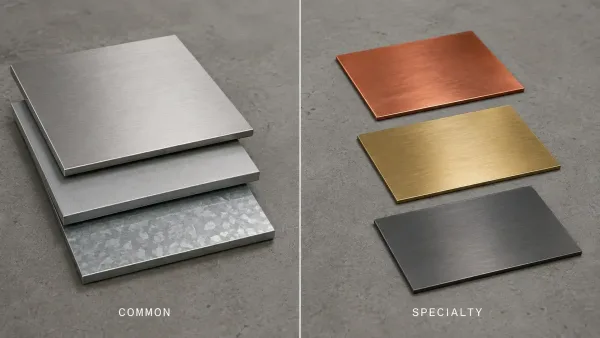
Gängige Legierungen wie Edelstahl 304 und Aluminium sind weit verbreitet auf Lager und werden in Tagen beschafft, während Spezialmetalle wie Titan und Inconel 1–3 zusätzliche Wochen für die Beschaffung benötigen.
Speziallegierungen — Kupfer, Messing, Titan oder Inconel — werden von Perforationsbetrieben selten auf Lager gehalten. Die Bestellung dieser Materialien bei einem Walzwerk oder Spezialhändler kann 1 bis 3 Wochen hinzufügen, bevor die Produktion überhaupt beginnt.
Wenn Ihr Projekt Materialflexibilität zulässt, kann die Wahl einer weit verbreiteten Legierung die Gesamtlieferzeit erheblich verkürzen.
Lochmuster und Blechdicke
Die Geometrie des Lochmusters beeinflusst direkt, wie lange der Produktionslauf dauert. Standardmuster — runde Löcher in versetzter oder gerader Anordnung mit Durchmessern von 3 mm bis 10 mm — sind am schnellsten zu produzieren. Viele Perforationsbetriebe halten Werkzeuge für diese Muster vorrätig, wodurch Rüstverzögerungen entfallen.
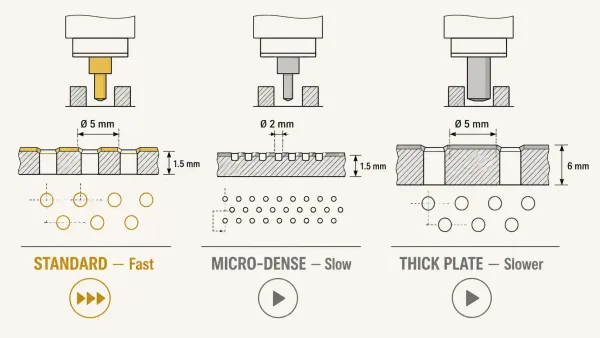
Standard-Rundlochmuster (3–10 mm) werden mit vorhandenen Werkzeugen am schnellsten perforiert, während kleinlochige, hochdichte oder dickplattige Muster die Produktionsgeschwindigkeit erheblich reduzieren.
Nicht standardmäßige Muster erhöhen die Zeit auf zwei Arten:
- Werkzeugvorbereitung. Kundenspezifische Stanzwerkzeuge oder Matrizen müssen möglicherweise bestellt oder hergestellt werden, was 5 bis 10 Arbeitstage je nach Komplexität dauern kann.
- Perforationsgeschwindigkeit. Kleine Lochdurchmesser (unter 2 mm), hochdichte Muster (offene Fläche über 60%) und dicke Platten (über 3 mm) reduzieren alle die Geschwindigkeit des Stanz- oder Laserprozesses. Ein Blech, das mit einem Standardmuster 2 Minuten zum Perforieren benötigt, könnte mit einem dichten Mikroperforationslayout 8 bis 10 Minuten benötigen.
Die Blechdicke spielt eine Doppelrolle. Sehr dünne Bleche (unter 0,5 mm) erfordern sorgfältige Handhabung, um Verformung während der Perforation zu vermeiden, was die Produktion verlangsamt. Dicke Platten (über 3 mm) erfordern mehr Kraft pro Stanzvorgang, was den Durchsatz reduziert.
Oberflächenbehandlung und Nachbearbeitung
Die Perforation ist selten der letzte Schritt. Die meisten Lochbleche durchlaufen mindestens einen Blechbearbeitungsprozess bevor sie einsatzbereit sind. Jede Behandlung fügt ihre eigene Lieferzeit hinzu:
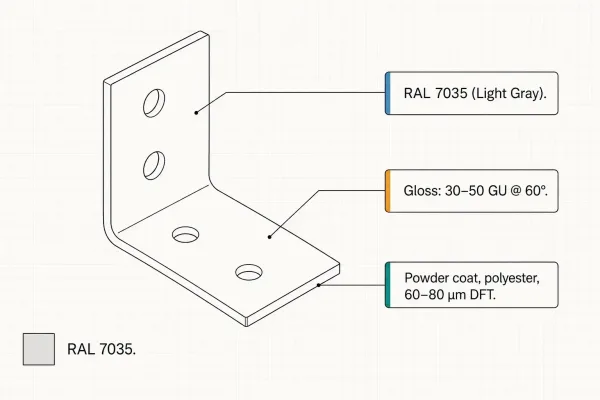
Oberflächenbehandlungen wie Feuerverzinkung, Pulverbeschichtung, Anodisierung, Elektropolieren und Lackieren fügen jeweils 3–10 Werktage zur Gesamtlieferzeit hinzu.
| Oberflächenbehandlung | Typische zusätzliche Lieferzeit |
|---|---|
| Feuerverzinkung | 3–5 Werktage |
| Pulverbeschichtung | 5–7 business days |
| Anodizing (aluminum) | 5–10 Werktage |
| Electropolishing (stainless) | 3–5 Werktage |
| Painting or wet coating | 3–5 Werktage |
These timelines assume the treatment is done by a subcontractor, which is common for most perforation shops. If the galvanizing or coating facility has a backlog — which happens frequently during peak construction season — the wait can extend by another week.
Planning for surface treatment from the start, rather than adding it as an afterthought, is one of the easiest ways to keep your delivery date on track.
Lagerware vs. kundenspezifische Lochbleche — Lieferzeitvergleich
For many projects, the first decision is whether to order from stock or commission a custom sheet metal fabrication run. The right choice depends on your specifications, volume, and how much schedule flexibility you have.
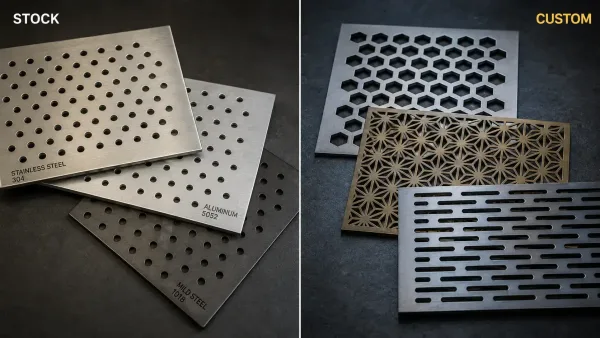
Stock perforated sheets offer fast delivery (3–5 days) with standard patterns, while custom orders match exact design specifications but require 2–4 weeks.
When Stock Perforated Sheets Make Sense
Stock perforated sheets are pre-manufactured panels in common materials (typically steel, stainless steel, or aluminum) with standard round-hole or slotted patterns. They are available from metal distributors and perforation suppliers in standard sheet sizes — often 4 ft × 8 ft (1219 mm × 2438 mm) or 1 m × 2 m.
Stock sheets ship fast, often within 3 to 5 business days. They work well when:
- Your design accepts standard hole sizes (typically 3 mm to 10 mm diameter)
- Material grade is common (304 stainless, mild steel, aluminum 5052)
- Sheet size matches standard dimensions or can be cut down from them
- Volume is moderate and does not justify a custom tooling investment
The trade-off is limited customization. You cannot specify exact hole pitch, non-standard hole shapes, or unusual sheet dimensions with stock panels.
When Custom Perforated Sheets Are Necessary
Custom perforation is required when your design calls for:
- Non-standard hole shapes (hexagonal, square, decorative patterns)
- Specific hole diameter, pitch, or open area percentage
- Non-standard sheet sizes or thicknesses
- Materials not stocked in perforated form
- Tight tolerances on hole placement or edge distances
Custom orders typically require 2 to 4 weeks from the Auftragsbestätigungsdatum to shipment, depending on the factors outlined in the previous section. The timeline includes material procurement (if not in stock), tooling setup, perforation, surface treatment, and inspection.
For high-volume projects, the upfront tooling cost is amortized across the order quantity, making custom perforation cost-effective at scale. For low-volume runs, the tooling cost per part is higher, but the ability to meet exact design requirements often justifies the premium.
A Decision Framework
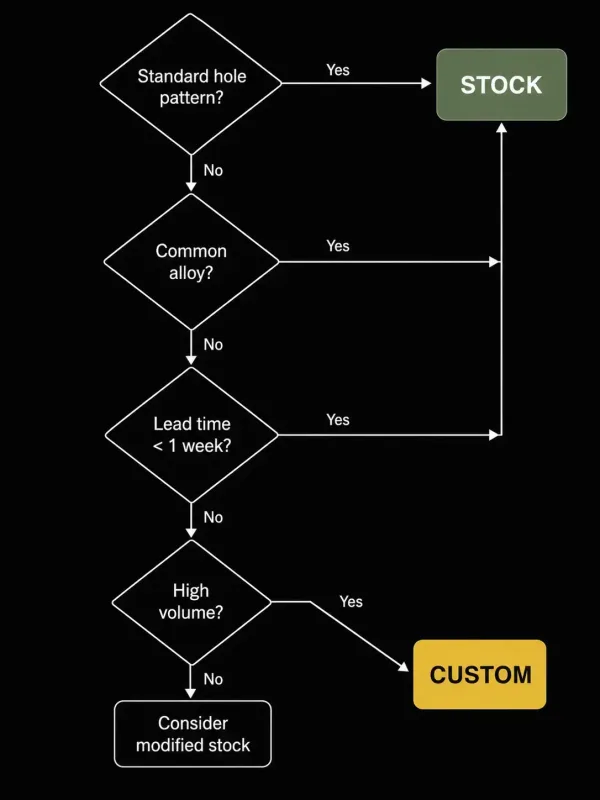
A step-by-step decision guide: evaluate hole pattern, material, lead time, and volume requirements to determine whether stock or custom perforated sheets are the right choice.
| Faktor | Choose Stock | Choose Custom |
|---|---|---|
| Hole pattern | Standard round/slotted | Non-standard or decorative |
| Material | Common alloys (304 SS, aluminum) | Specialty alloys or specific grades |
| Lead time available | Less than 1 week | 2+ weeks |
| Volume | Low to moderate | Moderate to high |
| Design flexibility | Can adjust to available specs | Must match exact drawings |
If your timeline is tight and your design can tolerate minor adjustments to hole size or pitch, ask your supplier whether a stock panel can be modified — for example, cut to size or deburred — to meet your needs faster than a fully custom order.
Wie die Materialauswahl die Verfügbarkeit beeinflusst
Material selection is often driven by corrosion resistance, strength, or weight requirements. But supply availability should also factor into the decision, especially when lead time is critical.
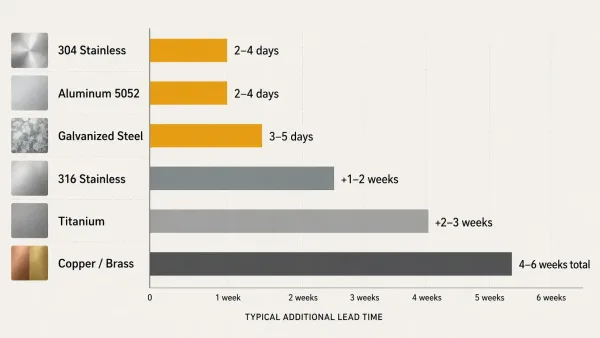
304 stainless steel and aluminum source in days, while 316 stainless adds 1–2 weeks, and specialty metals like copper and brass can extend total lead time to 4–6 weeks.
Stainless Steel 304 vs. 316 — Which Is Easier to Source?
Type 304 stainless steel is the most widely available stainless grade globally. Metal distributors and perforation suppliers stock it in a broad range of sheet sizes and thicknesses. If your application does not require the enhanced chloride resistance of 316, choosing 304 typically shortens material procurement to a few days.
316 stainless steel offers superior corrosion resistance, particularly in marine or chemical environments. However, it is less commonly stocked in sheet form, and specialty thicknesses may need to be ordered from the mill. Expect an additional 1 to 2 weeks for 316 procurement compared to 304, depending on the required thickness and sheet size.
Aluminum, Galvanized Steel, and Specialty Metals
Aluminium (commonly 5052-H32 or 6061-T6) is widely available and perforates well. Aluminum sheets are lighter than steel, which can reduce shipping costs and lead time for the logistics leg. Anodizing — a common surface treatment for aluminum — adds 5 to 10 days to the total timeline.
Verzinkter Stahl is available in pre-galvanized form (galvanized before perforation) or can be galvanized after perforation (post-galvanized). Pre-galvanized sheets are faster to source but may show minor coating disruption around the punched holes. Post-galvanizing ensures full coating coverage but adds the galvanizing lead time to the total.
Copper and brass are specialty materials for perforation. They are not commonly stocked in perforated form and require sourcing from non-ferrous metal distributors. Combined with slower perforation speeds (copper is softer and requires adjusted punch parameters), total lead times for copper perforated sheets can reach 4 to 6 weeks.
Wie Lochmuster und Blechdicke die Produktionszeit beeinflussen
Not all perforation jobs are equal from a manufacturing perspective. Two designs that look similar on paper — say, a 5 mm round-hole pattern and a 2 mm round-hole pattern — can have dramatically different production times.
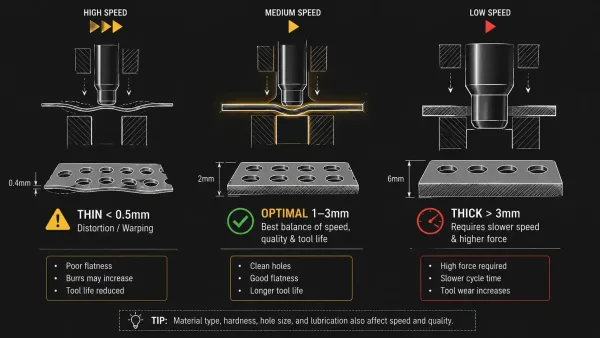
Sheets between 1 mm and 3 mm thickness offer the fastest production — thick enough to handle cleanly, thin enough to perforate efficiently.
Standard vs. Non-Standard Hole Patterns
Standard patterns use commonly available tooling. Round holes in staggered rows, with diameters between 3 mm and 12 mm and open areas below 50%, fall into this category. Many perforation shops maintain a library of standard punch tools for these patterns, meaning no tooling lead time.
Non-standard patterns — including hexagonal holes, decorative shapes, custom slot dimensions, or very high open areas (above 60%) — require custom tooling. The tooling itself may take 5 to 10 working days to manufacture. Once the tooling is ready, the perforation process is slower because custom patterns often require more punches per sheet and tighter alignment control.
If your design allows it, selecting a hole diameter and pitch that matches your supplier’s existing tooling library can eliminate the tooling lead time entirely.
Thin Gauge vs. Thick Plate
Thin sheets (below 0.5 mm) perforate quickly in terms of punch force, but they are prone to warping and distortion during the process. Operators run thinner sheets at slower speeds and may need additional flattening steps afterward, which adds time.
Thick plates (above 3 mm) require significantly more punch force, reducing the number of holes the machine can punch per minute. For plates above 6 mm, some suppliers switch from mechanical punching to laser perforation, which is more precise but slower for high-volume runs.
The sweet spot for fast production is typically 1 mm to 3 mm thickness in standard materials — thick enough to handle cleanly, thin enough to perforate efficiently.
Praktische Tipps zur Verkürzung Ihrer Lieferzeit für Lochbleche
Understanding the variables is the first step. The second is acting on that knowledge when you plan your order. Here are strategies that procurement teams and engineers can use to reduce delivery time:
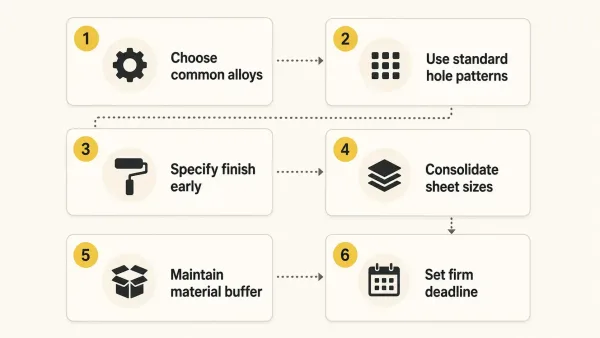
Six actionable strategies including choosing common materials, using standard patterns, specifying surface treatment early, consolidating sizes, maintaining material buffers, and communicating deadlines upfront.
- Choose widely available materials. If 304 stainless meets your corrosion requirements, avoid specifying 316 unless necessary. Material sourcing is often the largest single variable in total lead time.
- Use standard hole patterns when possible. Matching your supplier’s existing tooling library eliminates tooling preparation time entirely. Ask your supplier for their standard pattern catalog before finalizing your design.
- Specify surface treatment early. Adding galvanizing or powder coating after the order is placed extends the timeline. If you know the finished part needs a coating, include it in the original specification so the supplier can schedule it in parallel with perforation.
- Consolidate sheet sizes. If your project requires multiple perforated panels, standardizing on one or two sheet sizes allows the supplier to batch production runs, which is faster than processing each size separately.
- Maintain a material buffer. For recurring orders, consider working with your supplier to maintain a small stock of your specified material. This eliminates procurement lead time for repeat orders and can reduce delivery to the perforation and finishing cycle alone.
- Communicate your deadline upfront. Suppliers prioritize orders differently based on confirmed delivery dates. Providing a firm target date at the quoting stage allows the production team to plan capacity and flag potential conflicts early.