
Vorbereitung vor der Angebotsanfrage
BVor dem Versand einer RFQ hat die Qualität Ihrer Vorbereitung einen direkten Einfluss auf die Angebotsgenauigkeit und die Reaktionszeit. Basierend auf Branchenerfahrung können gut vorbereitete Anfragen den Angebotszyklus um durchschnittlich 2–3 Tage verkürzen und die Folgekommunikationskosten um bis zu 40% senken.
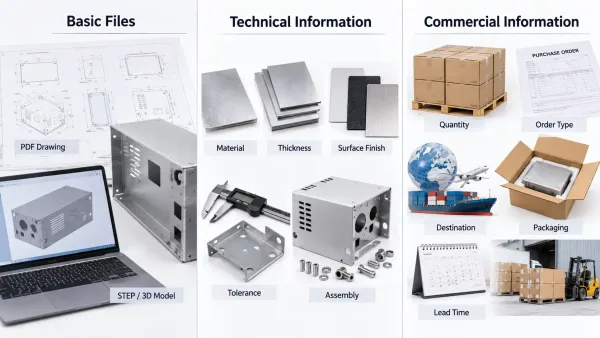
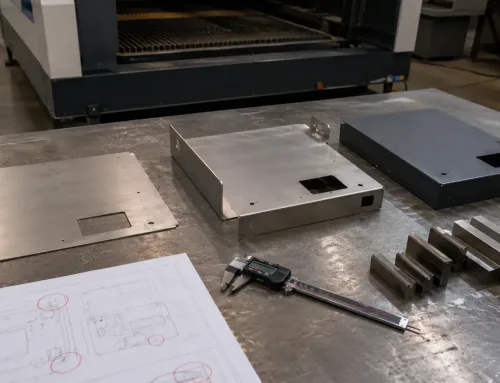
Die drei Hauptkategorien von Informationen, die für eine präzise Blech-RFQ erforderlich sind: Zeichnungen, technische Spezifikationen und kommerzielle Anforderungen.
Drei wesentliche Informationskategorien
Basisdokumente
2D-Zeichnungen (PDF-Format): Abmessungen, Toleranzen und technische Hinweise angeben;
3D-Dateien (STEP / IGES-Format): Helfen Lieferanten, komplexe Strukturen und Montagebeziehungen besser zu verstehen;
Praktischer Tipp: STEP wird im Allgemeinen gegenüber IGES bevorzugt, da es komplexe Oberflächen besser verarbeitet und eine zuverlässigere Kompatibilität über CAD-Software hinweg bietet.
Technische Informationen
Materialgüte: Wie SUS304, AL6061 oder Q235. Vermeiden Sie vage Beschreibungen wie “Edelstahl” oder “Aluminiumlegierung” allein;
Dicke: Klar angeben, idealerweise mit zwei Dezimalstellen, wie 1,50 mm oder 2,00 mm;
Oberflächenbehandlung: Zum Beispiel Pulverbeschichtung, Eloxieren, Galvanisieren, Bürsten usw.;
Toleranznorm: Wie ISO 2768-m, JIS oder klar definierte Toleranzen für kritische Abmessungen;
Montageanforderungen: Angeben, ob das Teil mit anderen Komponenten zusammenpassen muss und ob Spielanforderungen gelten;
Kommerzielle Informationen
Zielbestellmenge: Musterbestellmenge vs. Produktionsmenge, da die Preisgestaltung um das 3- bis 5-Fache abweichen kann.
Bestellart: Prototyp, Kleinserien-Pilotlauf oder Massenproduktion.
Bestimmungsland oder -region: Dies beeinflusst Zölle, Versandmethoden und Verpackungsstandards.
Verpackungsanforderungen: Zum Beispiel Exportverpackung, ESD-Schutz, Vakuumverpackung usw.
Ziel-Lieferzeit: Geben Sie Ihren erwarteten Lieferplan klar an.
Wichtige Informationen für ein schnelles vorläufiges Angebot
Wenn die Zeit begrenzt ist, reichen in der Regel die folgenden fünf Angaben aus, damit ein Lieferant ein erstes Angebot erstellen kann:
- PDF-Zeichnung
- Materialgüte
- Dicke
- Menge
- Anforderung an die Oberflächenbehandlung
Wie Sie eine effektive RFQ einreichen
Eine klare und gut strukturierte RFQ hilft Herstellern nicht nur, präzise Angebote zu erstellen, sondern zeigt auch Ihre Professionalität, was oft zu einer reaktionsschnelleren und proaktiveren Unterstützung durch Lieferanten führt.
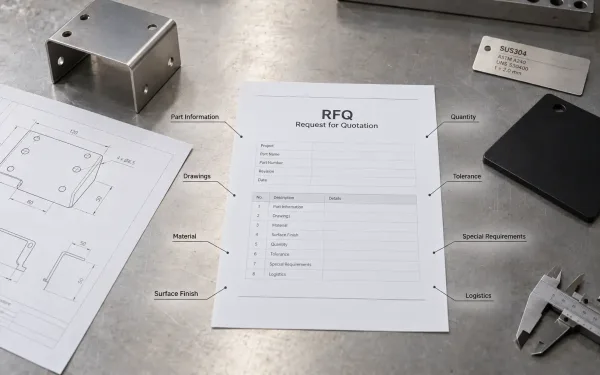
Eine strukturierte Blech-RFQ mit Zeichnungen, Materialspezifikationen, Mengen, Toleranzen, Oberflächenbehandlung, Qualität und Logistikanforderungen.
Empfohlene Informationen für eine RFQ
| Informationskategorie | Details | Wichtigkeit |
|---|---|---|
| Grundlegende Teileinformationen | Teilebezeichnung, Zeichnungsnummer, Anwendung | ⭐⭐ |
| Drawing Files | PDF + STEP/IGES | ⭐⭐⭐ |
| Material Specifications | Grade, thickness, hardness | ⭐⭐⭐ |
| Oberflächenbehandlung | Finish type, color, coating thickness | ⭐⭐⭐ |
| Quantity Information | Sample quantity, production quantity, annual forecast | ⭐⭐⭐ |
| Tolerance Requirements | General tolerances or critical dimension callouts | ⭐⭐ |
| Special Requirements | Cosmetic surface requirements, assembly requirements, inspection requirements | ⭐⭐ |
| Logistics Information | Delivery address, packaging requirements | ⭐⭐ |
Muster-RFQ-Vorlage
Tips for Speeding Up the Quotation Process
- Provide clear drawings: Complete and well-annotated drawings can reduce follow-up clarification time by as much as 60%;
- Share your annual demand forecast: Suppliers are more likely to offer more competitive pricing when they understand the total business potential;
- Highlight critical dimensions: Mark critical dimensions with circles or bold callouts to avoid unnecessary overprocessing;
- Clearly distinguish samples from production: Sample orders and production orders are often handled very differently, and pricing can vary by 3 to 5 times;
What Factors Affect Pricing?
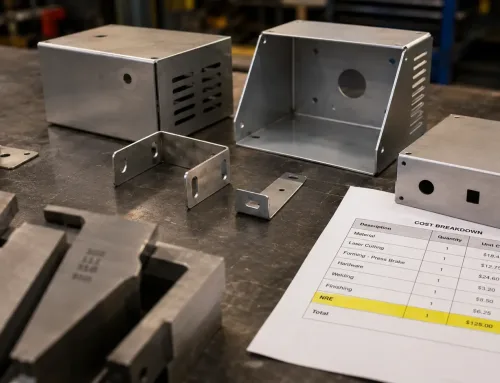
Understanding what goes into a quotation helps you take better control of costs during both the design and procurement stages.
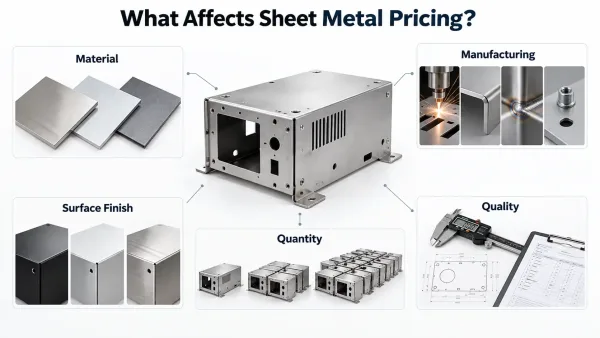
The main factors affecting sheet metal fabrication cost, including material, manufacturing complexity, surface finishing, quality requirements, and order quantity.
1. Material-Related Factors (Typically 30–50% of Total Cost)
| Faktor | Auswirkung | Hinweise |
|---|---|---|
| Werkstofftyp | ⭐⭐⭐ | Stainless steel generally costs more than aluminum, which in turn costs more than cold-rolled steel |
| Materialgüte | ⭐⭐⭐ | SUS316L can cost 40–60% more than SUS304 |
| Materialdicke | ⭐⭐⭐ | As thickness increases, material cost rises proportionally, and fabrication becomes more difficult |
Hinweis: When performance requirements allow, optimizing the material grade can reduce costs by 20–30%. For example, using SUS304 instead of SUS316 in non-corrosive environments, or AL5052 instead of AL6061 where appropriate.
2. Manufacturing-Related Factors (Typically 30–40% of Total Cost)
- Cutting complexity: The longer the laser cutting path, the higher the cost. When hole diameters are smaller than the sheet thickness, special processing may be required, which can increase cost significantly;
- Number of bends: Each additional bend typically adds around 5–10% to the fabrication cost;
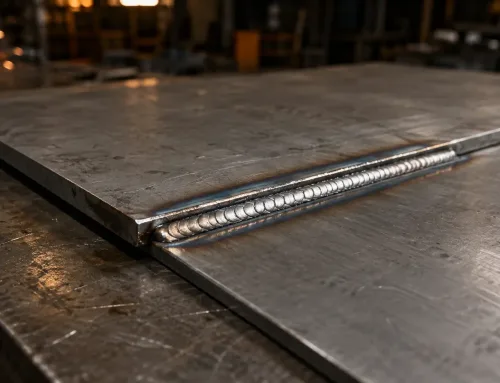
- Welding requirements: The cost difference between continuous welds and spot welds can be as much as 2 to 3 times;
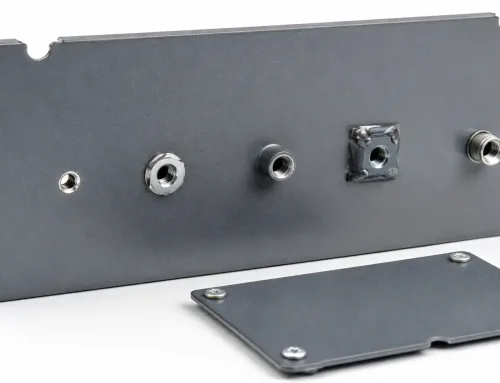
- PEM inserts / fasteners: Each inserted fastener typically adds about RMB 0.5 to 1.0 in combined material and labor cost.;
- Assembly operations: Additional assembly steps such as riveting, bolting, or welded sub-assemblies will also affect pricing;
3. Surface Finishing Factors (Typically 10–20% of Total Cost)
| Finish Type | Relative Cost (vs. powder coating) | Typische Anwendung |
|---|---|---|
| Pulverbeschichtung | 1.0x | Most common and generally the most cost-effective |
| Eloxieren | 1.2–1.5x | Aluminum parts requiring higher corrosion resistance |
| Galvanisieren | 1.5–2.0x | Applications requiring conductivity or decorative appearance |
| Brushing | 1.1–1.3x | Parts with decorative surface requirements |
4. Quality Requirement Factors
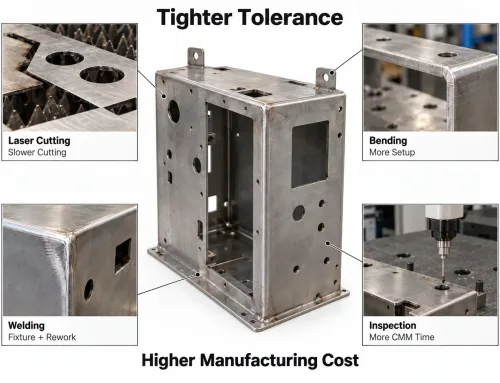
- Tighter tolerances: A tolerance of ±0.05 mm instead of ±0.1 mm can increase cost by 30–50%;
- Cosmetic requirements: Visible surfaces often require finer polishing and better protection, which can add 15–25% to the cost;
- Inspection and reporting requirements: Third-party inspections and FAI reports will increase quality-related costs;
5. Quantity-Related Factors
| Order Type | Quantity Range | Relative Unit Price |
|---|---|---|
| Samples | 1–10 pcs | 3–5x |
| Low-volume | 10–100 pcs | 2–3x |
| Medium-volume | 100–1,000 pcs | 1.2–1.5x |
| High-volume | Over 1,000 pcs | 1.0x (baseline) |
What Factors Affect Lead Time?
In manufacturing, lead time management is one of the biggest challenges in procurement. Understanding what makes up the lead time is essential for planning your project schedule more effectively.
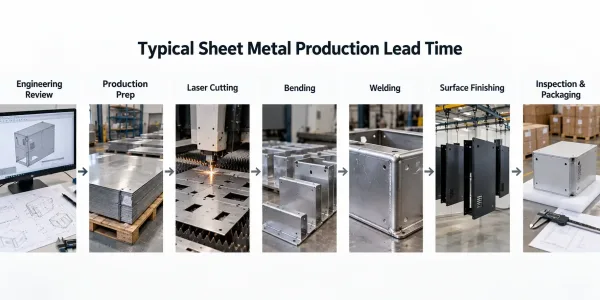
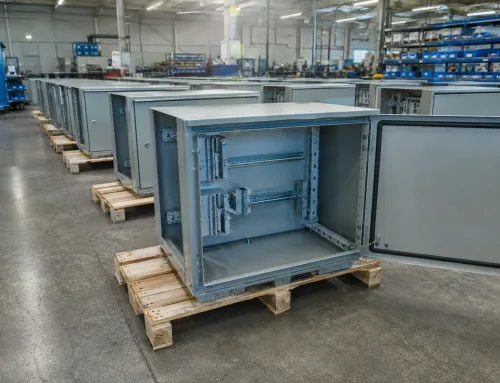
Typical sheet metal production stages from engineering review through cutting, bending, welding, finishing, inspection, and packaging.
Typical Lead Time Breakdown for a Production Order
| Stage | Time Share | Hinweise |
|---|---|---|
| Engineering review | 1–2 days | Drawing review, process evaluation, quotation confirmation |
| Production preparation | 1–2 days | Material cutting prep, tooling setup, process documentation |
| Laserschneiden | 1–2 days | Depends on part complexity and quantity |
| Biegen / Umformen | 1–2 days | Depends on the number of bends and part volume |
| Welding / assembly | 1–2 days | Depends on weld length and assembly complexity |
| Surface finishing | 1–2 days | Usually outsourced and dependent on the finishing supplier |
| Inspection & packaging | 1–2 days | Dimensional inspection and packing |
| Total | 8–20 days | Varies depending on order size and complexity |
Key Variables That Affect Lead Time
1. The impact of order quantity
- Prototype orders: 5–10 days. These are often prioritized in scheduling, but each part is processed individually;
- Repeat orders: Lead time can be reduced by 30–40% because the process has already been validated and tooling is already in place;
- Production orders: 10–20 days, as multiple processes and outside suppliers often need to be coordinated;
2. Surface finishing is often the biggest source of uncertainty
- Powder coating: 2–3 days;
- Anodizing: 3–5 days, as it may involve multiple steps such as polishing, anodizing, and sealing;
- Electroplating: 3–7 days, often affected by environmental regulations and plating capacity;
3. Unclear requirements early on are one of the main causes of delays
According to supplier experience, 60–70% of lead time delays come from technical details not being confirmed in advance, which can lead to:
-
Production being paused while waiting for clarification;
-
Rework or design revisions;
-
Last-minute changes to materials or surface finishes;
How Do Prototype Orders Differ from Production Orders?
When reviewing RFQs, we often find that many customers treat prototype orders and production orders as if they were the same. In reality, however, they require completely different purchasing strategies.
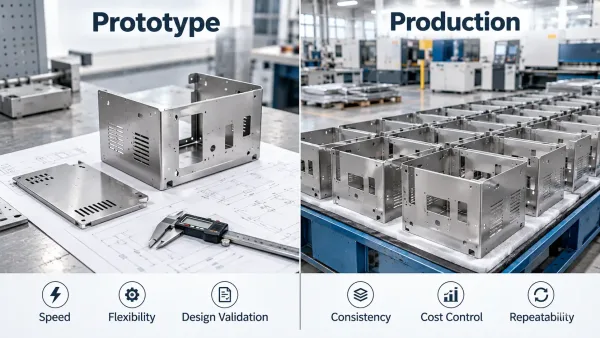
Comparison between prototype and production sheet metal orders in terms of speed, flexibility, consistency, inspection, and volume.
Hauptunterschiede auf einen Blick
| Kategorie | Prototype Orders | Production Orders |
|---|---|---|
| Hauptziel | Validate the design and test functionality | Control costs and ensure consistency |
| Main priority | Speed and flexibility | Stability and repeatability |
| Acceptable cost | Higher, often 3–5 times the production unit cost | As low as possible |
| Lead time expectation | 5–10 days | Planned according to order volume |
| Tolerance requirements | Functional dimensions only need to meet design intent | Tight consistency is required across all parts |
| Packaging requirements | Basic protection is usually sufficient | Standardized and controlled packaging is expected |
| Prüfmethode | Focused mainly on functional verification | Typically based on statistical sampling inspection, such as AQL |
Checklist Before Moving from Prototype to Production
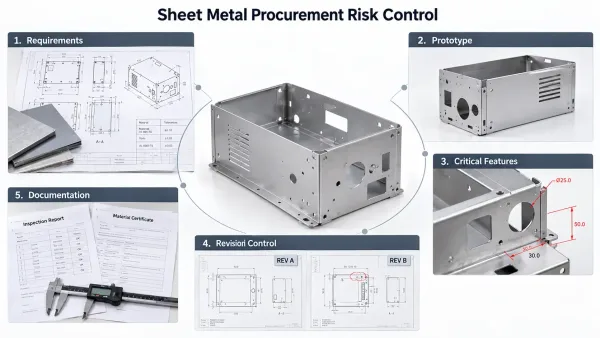
Recommended Quality Requirements to Confirm Before Placing an Order
Unclear quality expectations are one of the main causes of rework and disputes. Before placing an order, it is best to confirm the following four categories of requirements.
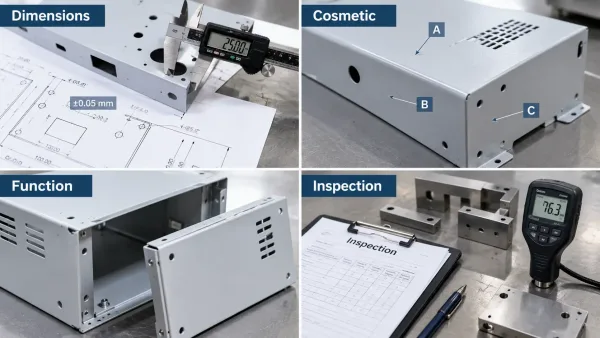
Key quality requirements for sheet metal parts covering dimensions, cosmetic surfaces, functional fit, and final inspection.
1. Dimensional Requirements
| Anforderungstyp | Beschreibung | Gängige Normen |
|---|---|---|
| General tolerances | Default tolerances for non-critical dimensions | ISO 2768-m / JIS fine grade |
| Special tolerances | Tolerances for critical fit-related dimensions | ±0.01 mm to ±0.05 mm |
| Kritische Maße | Dimensions that affect assembly or function | 100% inspection |
Hinweis: Avoid applying tight tolerances to every dimension, as this can drive costs up quickly. A better approach is to use tight tolerances for critical dimensions and standard tolerances for general dimensions.
2. Cosmetic Requirements
Scratch standards:
-
Minor scratches: depth < 0.05 mm, length < 5 mm, with an acceptable quantity limit
-
Major scratches: depth > 0.05 mm, length > 10 mm, not acceptable
Cosmetic surface classification:
-
Surface A: Main visible surface, highest standard
-
Surface B: Side visible surface, medium standard
-
Surface C: Non-visible surface, lowest standard
Surface consistency: Consistency of color and texture across parts within the same batch
Coating quality: Adhesion (cross-hatch test 4B or above), hardness (pencil hardness H or above)
3. Functional Requirements
- Hole fit: Clearance requirements for fasteners, connectors, or mating parts
- Bend angle: Bend angle tolerance, typically ±1°
- Assembly fit: Actual fit testing with mating parts
- Weld strength: Pull testing or destructive testing, if required
4. Inspection Requirements
Routine inspections: First article inspection, in-process inspection, and final pre-shipment inspection
First article inspection: Full dimensional inspection of the first part in each batch
100% inspection: Confirm whether critical dimensions require full inspection
Required inspection reports:
-
Dimensional inspection report
-
Material certificate
-
Surface finish report, such as coating thickness and adhesion test results
Packaging & Shipping Requirements
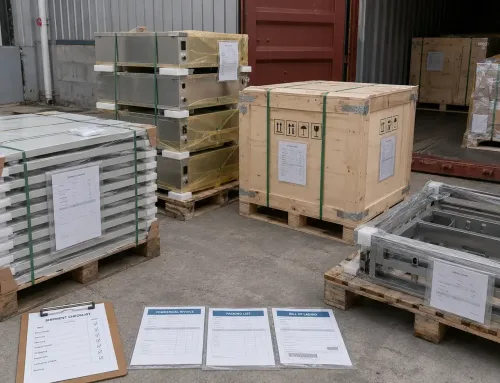
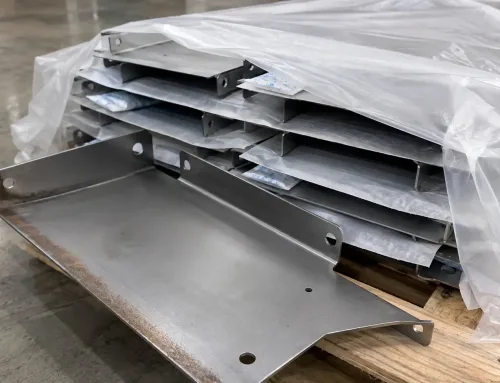
Packaging typically accounts for 2–5% of total cost, but the losses caused by poor packaging can easily exceed the value of the parts themselves.
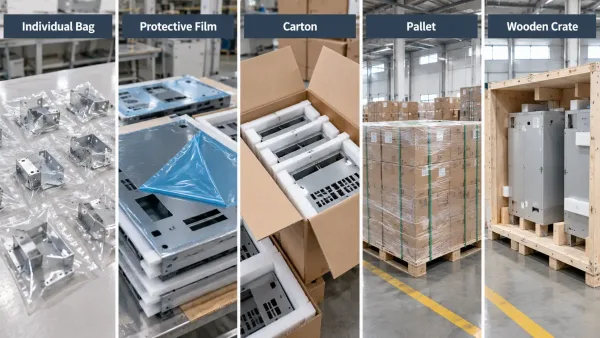
Common packaging methods for sheet metal parts including protective film, cartons, pallets, wooden crates, and kit-based packaging.
Common Packaging Methods and Their Typical Applications
| Packaging Method | Relativer Kostenaufwand | Typische Anwendung |
|---|---|---|
| Individual bagging | 1.0x | Small parts, cosmetic parts |
| Protective film | 1.1x | Cosmetic parts, scratch-sensitive parts |
| Carton packaging | 1.2x | Small to medium production runs, domestic shipping |
| Pallet packaging | 1.5x | Volume orders, easier warehousing and handling |
| Wooden crate packaging | 2.0x | Large parts, precision parts, export shipments |
Packaging Details to Confirm Before Placing an Order
- Whether export packaging is required, such as fumigated wooden crates compliant with ISPM 15
- Whether scratch protection is needed, such as protective film or foam interlayers
- Whether part labels are required, including part number, batch number, and quantity QR code
- Whether parts should be packed together or separately
- Whether parts should be packed by set, with all components for one product grouped in the same package
Hinweis: For assembly operations, it is often best to use kit-based packaging, where all parts required for one finished product are packed together. This helps reduce warehouse picking time and improves efficiency.
Can You Still Source Parts Without a Complete Drawing?
This is a very common real-world situation. At SR MFG, around 60% of first-time RFQs come in with incomplete information. In these cases, a phased sourcing approach is often the most practical solution.
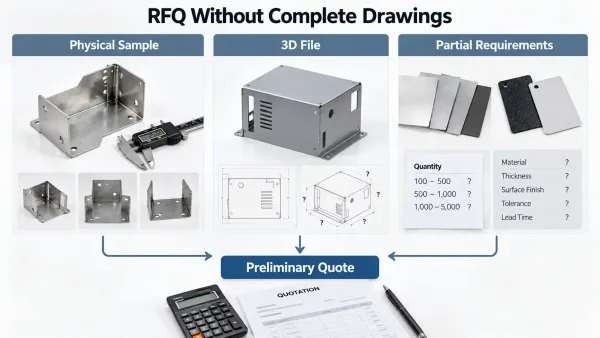
Three sourcing paths for incomplete RFQs: physical samples, 3D files, and partially defined technical requirements.
Sourcing Paths Based on Incomplete Information
1. Only a physical sample is available
A preliminary evaluation and quotation can still be provided. It is helpful to supply:
- Clear photos from multiple angles
- Key dimensions, such as length, width, hole diameter, and hole locations
- A preliminary assessment of the material, for example using a handheld spectrometer
The supplier can then reverse-engineer the part and prepare drawings for confirmation.
2. Only a 3D file is available
A 3D file is useful for understanding the structure and assembly relationship of the part. However, production details still need support from a 2D drawing, such as:
- Bend allowance or flat pattern details
- Hole tolerances
- Surface finish callouts and finish areas
An initial quotation can usually be provided first, with the 2D drawing added later.
3. Some requirements have not yet been fully defined
- If the material is not yet confirmed, the supplier can recommend suitable options based on the application
- If tolerances are not defined, pricing can be based on standard tolerances first and adjusted later if needed
- If the surface finish is still undecided, multiple finishing options and cost comparisons can be provided
- If the quantity is not finalized, tiered pricing can be offered for different volume levels
Hinweis: A supplier’s engineering capability is often a key differentiator. A strong supplier will actively support early-stage design optimization, helping reduce cost and improve manufacturability.
Common Mistakes When Sourcing Sheet Metal Parts
Based on SR MFG’s experience, here are some of the most common mistakes buyers make when sourcing sheet metal parts—and how to avoid them.
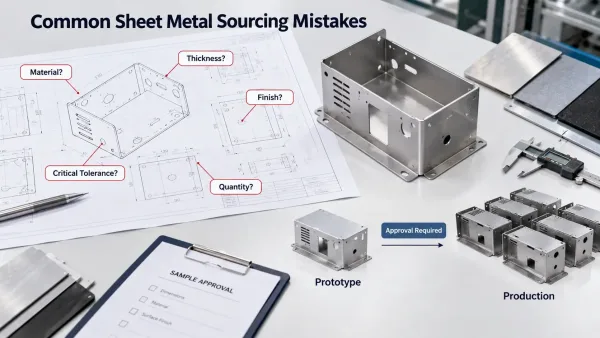
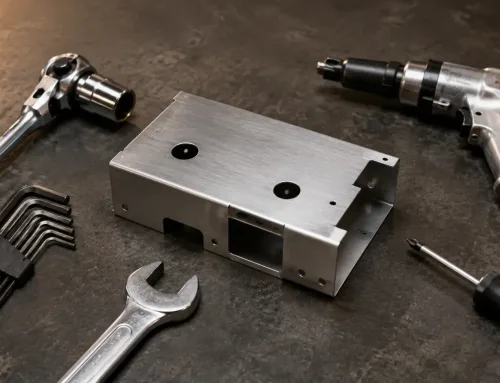
Common RFQ and sourcing mistakes involving incomplete drawings, missing material specifications, unclear tolerances, quantity, finishing, and prototype approval.
Top 10 Common Mistakes
| Mistake | Auswirkung | How to Avoid It |
|---|---|---|
| Material not specified on the drawing | No accurate quote can be provided, leading to repeated clarification | Always specify the exact material grade |
| Thickness not specified | Affects both cost and process selection | Clearly define the material thickness and tolerance |
| Quantity not provided | Makes accurate pricing impossible | Provide at least an estimated quantity range |
| Surface finish not specified | Can result in major price differences | Clearly state the required surface finish |
| Tight tolerances applied to every dimension | Can dramatically increase cost | Distinguish critical dimensions from general dimensions |
| Critical dimensions not identified | Increases quality risk | Highlight critical dimensions with circles or bold callouts |
| Cosmetic surfaces not defined | Can lead to disputes over appearance quality | Mark A / B / C cosmetic surfaces on the drawing |
| Packaging requirements not communicated in advance | Increases the risk of shipping damage | Confirm packaging requirements before production |
| Urgent quote requested with incomplete information | Leads to inaccurate pricing | Provide at least the basic required information |
| Moving directly into production before prototype approval | Creates a high risk of batch rework | Follow a strict prototype approval process before mass production |
A Clear Procurement Process
Standardizing the procurement process helps reduce communication costs and improve overall efficiency. Below is a recommended workflow.
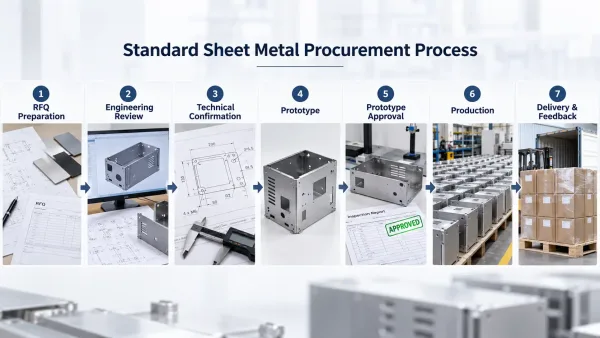
A seven-stage sheet metal procurement process from RFQ preparation and engineering review through prototype approval, production, and delivery.
Standard Procurement Process with Typical Timing
Key Points for Optimizing the Process
- The more effort invested upfront, the lower the downstream risk. Spending two extra days on a thorough engineering review can prevent ten days of rework later;
- Prototype approval is a critical milestone. Skipping the prototype stage and moving straight into mass production is rarely worth the risk;
- Keep a record of all communication. Technical confirmations should always be documented in writing, such as by email or marked-up drawing approvals;
- Build long-term supplier relationships. For repeat orders, lead times can often be reduced by 30–40%, and pricing may improve by 10–20%;
Checkliste für Schnellangebote
To wrap up, here is the most practical action checklist.
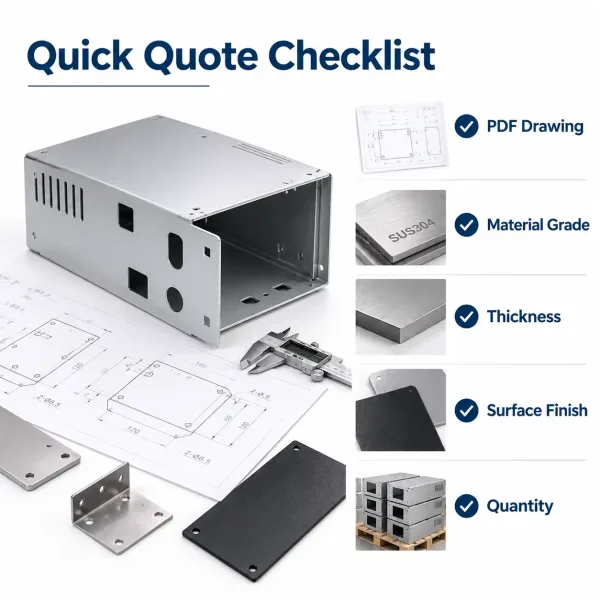
The five essential items needed for a preliminary sheet metal quote: drawing, material grade, thickness, surface finish, and quantity.
If you want to get a quote faster, please prepare the following information:
✅ Essential Information (at minimum, provide these 5 items)
| No. | Position | Beschreibung | Example |
|---|---|---|---|
| 1 | PDF-Zeichnung | Including dimensions and tolerance callouts | Enclosure_Panel_2D.pdf |
| 2 | Materialgüte | The exact grade must be specified | SUS304 |
| 3 | Materialdicke | Ideally specified to two decimal places | 2,0 mm |
| 4 | Oberflächenbeschaffenheit | Include both finish type and color | Black powder coating |
| 5 | Menge | Sample quantity plus estimated production volume | 5 prototype pieces, 500 production pieces |
Recommended Additional Information for More Accurate Pricing
- 3D file (STEP format) — helps suppliers understand complex structures
- Tolerance requirements (or clearly marked critical dimensions) — helps control cost
- Destination country / region — helps evaluate shipping and duties
- Target lead time — helps align with production planning
- Special requirements — such as cosmetic appearance, assembly, or packaging needs