
A Charge von pulverbeschichteten Blechgehäusen erreicht Ihre Montageanlage. Die Außenkartons sehen in Ordnung aus.
Doch als die Linie sie öffnet, haben sich braune Flecken entlang gebogener Kanten und um Befestigungslöcher gebildet — Bereiche, in denen die Beschichtung am dünnsten war oder in denen die Handhabung sie durch Kratzer beschädigt hat.
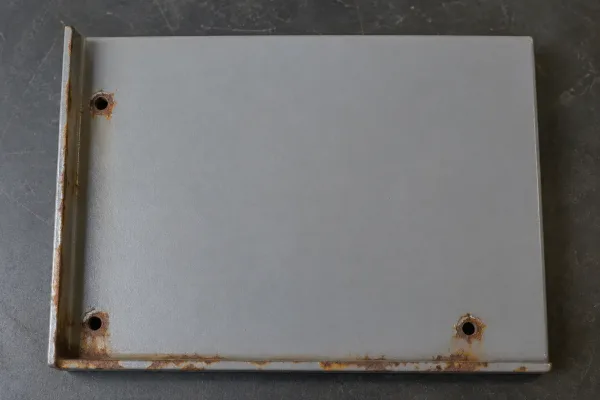
Dieses Bild zeigt eine pulverbeschichtete Gehäuseplatte, bei der sich braune Korrosion entlang gebogener Kanten und um Befestigungslöcher gebildet hat — die Bereiche, die am anfälligsten für Beschichtungsschäden und Feuchtigkeitseintritt sind.
Die Teile sind noch kein Ausschuss, aber sie müssen nachgearbeitet werden, bevor sie Ihren Kunden erreichen können. Sie haben gerade zwei Wochen und eine Marge verloren, die Sie nicht wieder hereinholen können.
Dieses Szenario ist nicht selten.
Feuchtigkeitsbedingte Korrosion während Lagerung und Transport ist eine der häufigsten — und am besten vermeidbaren — Ursachen für die Ablehnung von Blechteilen.
Die Lösung ist kein besserer Karton oder eine teurere Beschichtung. Es ist ein systematischer Ansatz, der beginnt, bevor das Teil überhaupt verpackt wird.
Warum Blechteile bei Lagerung und Transport korrodieren
Korrosion an Stahl- und Aluminiumteilen erfordert drei Dinge:
- Sauerstoff
- Feuchtigkeit
- eine Temperaturdifferenz, die Kondensation verursacht
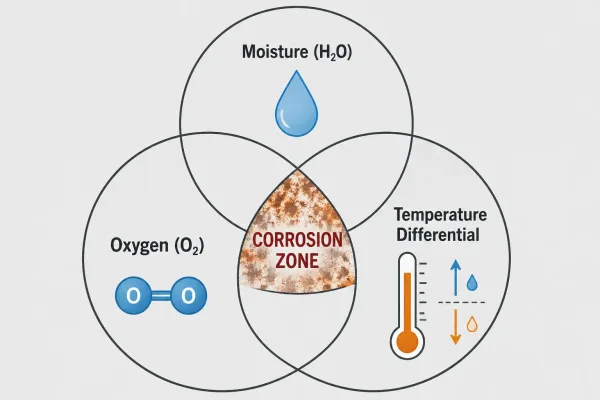
Dieses Diagramm veranschaulicht die drei Bedingungen, die vorhanden sein müssen, damit Korrosion an Blechteilen auftritt — Sauerstoff, Feuchtigkeit und eine Temperaturdifferenz, die Kondensation verursacht.
In einem versiegelten Überseecontainer sind alle drei vorhanden.
Die relative Luftfeuchtigkeit in einem Standardcontainer kann 98% bei Temperaturschwankungen erreichen, und salzhaltige Luft beschleunigt die elektrochemische Reaktion auf freiliegenden Metalloberflächen.
Selbst Teile, die am Werkstor trocken aussehen, können während des Transports korrodieren.
Restliches Bearbeitungskühlmittel, das in einem Biegeradius eingeschlossen ist, Fingerabdrücke von bloßen Händen oder ein mikroskopischer Kratzer in der Pulverbeschichtung — jeder dieser Punkte schafft einen Ausgangspunkt, an dem sich Feuchtigkeit sammelt und Oxidation beginnt.
Die Lehre ist eindeutig:
Korrosion wartet nicht auf offensichtliche Wassereinwirkung. Sie beginnt überall dort, wo eine anfällige Oberfläche auf feuchte Luft trifft.
Oberflächeninspektion vor dem Versand — Was vor dem Verpacken zu prüfen ist
Der wichtigste Schritt zum Feuchtigkeitsschutz erfolgt, bevor irgendein Verpackungsmaterial ausgewählt wird.
Ein Teil, das mit Oberflächenverunreinigung oder Beschichtungsschaden in die Verpackungsphase gelangt, wird korrodieren, unabhängig davon, wie gut es eingewickelt ist.
Dies ist die Phase, die die meisten Leitfäden überspringen, und es ist die Phase, in der Hersteller die größte Kontrolle haben.
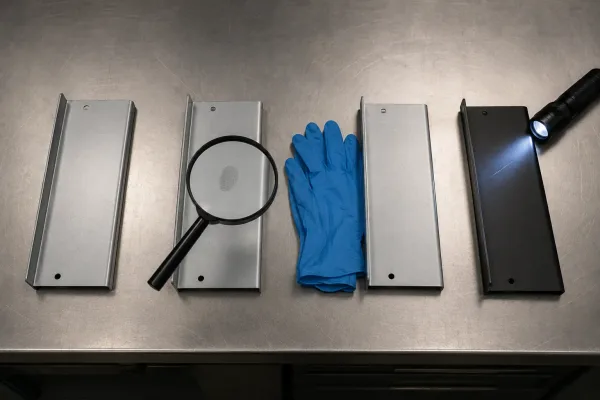
Dieses Bild zeigt die vier wichtigsten Inspektionsschritte vor dem Versand für Blechteile: Überprüfung der Trockenheit, Kontrolle auf Oberflächenrückstände, Sicherstellung einer sauberen Handhabung mit Handschuhen und Inspektion der Beschichtungsintegrität entlang der Kanten.
Bestätigen Sie vor dem Verpacken Folgendes bei jeder Charge:
- Trockenheit. Teile müssen nach der Endreinigung oder Oberflächenbehandlung vollständig trocken sein. Wasser, das in Bördelungen, Nähten oder Sacklöchern eingeschlossen ist, verursacht lokale Korrosion im Inneren der Verpackung.
- Rückstandsfreie Oberflächen. Bearbeitungsflüssigkeiten, Entfettungsmittel und Schweißspritzerreste sind hygroskopisch — sie ziehen Feuchtigkeit an und halten sie fest. Verifizieren Sie, dass die Reinigungsprozesse diese Verunreinigungen vollständig entfernt haben.
- Beschichtungsintegrität. Inspizieren Sie Blechoberflächenveredelung wie Pulverbeschichtung, Galvanisierung oder Eloxierung auf Kratzer, Abplatzungen oder dünne Stellen — besonders entlang von Biegungen, Kanten und um Befestigungslöcher. These are the first areas to corrode.
- No bare-hand contact. Skin oils are mildly acidic and create corrosion initiation sites. Parts should be handled with clean gloves from the final finishing step onward.
This Vorversandprüfung takes minutes per batch and prevents the most expensive failure mode:
A part that was properly coated, properly packed, and still corroded because it was not clean when it went into the box.
Feuchtigkeitsschutzstufen nach Oberflächenbehandlung
Not every part needs the same level of protection.
The risk depends primarily on the sheet metal surface finish — bare carbon steel is far more vulnerable than stainless steel or anodized aluminum, and the packaging approach should reflect that difference.
Treating all parts the same wastes material on low-risk items and under-protects high-risk ones.
The following framework categorizes sheet metal parts by corrosion risk based on their surface condition:
| Risk Level | Surface Condition | Corrosion Onset | Recommended Protection |
|---|---|---|---|
| Hoch | Bare cold-rolled steel, unfinished carbon steel | Hours to days in humid air | VCI film or paper + desiccant + sealed barrier bag |
| Mittel | Powder-coated, galvanized, zinc-plated | Days to weeks; starts at scratches or exposed edges | VCI paper or film + desiccant; sealed outer wrap |
| Niedrig | Stainless steel, anodized aluminum, copper with patina | Weeks to months; slow surface oxidation | Desiccant in sealed poly bag; VCI optional for long storage |
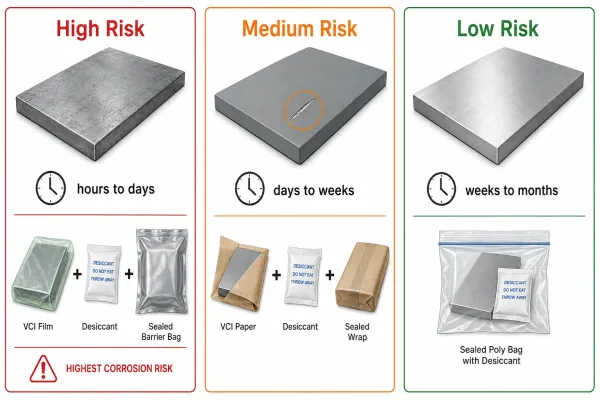
This infographic compares three corrosion risk levels based on surface finish type, showing the expected corrosion onset time and the recommended packaging protection for each level.
A common mistake is assuming that the corrosion resistance of metal finishes such as powder coating or galvanizing eliminates the need for moisture protection.
It does not.
A corrosion protection coating can delay corrosion, but it does not prevent attack at damaged or exposed areas.
For export shipments with transit times exceeding four weeks, even medium-risk parts benefit from VCI protection.
Verpackungsmethoden — Den richtigen Schutz wählen
Once surface inspection is complete and the risk level is determined, the next step is selecting a packaging method that matches:
- the part’s vulnerability
- the expected storage duration
- the expected transit duration
Three core approaches cover most sheet metal applications.
VCI (Vapor Corrosion Inhibitor) Film or Paper
VCI materials release a thin molecular layer that settles on metal surfaces and blocks the electrochemical reaction causing rust.
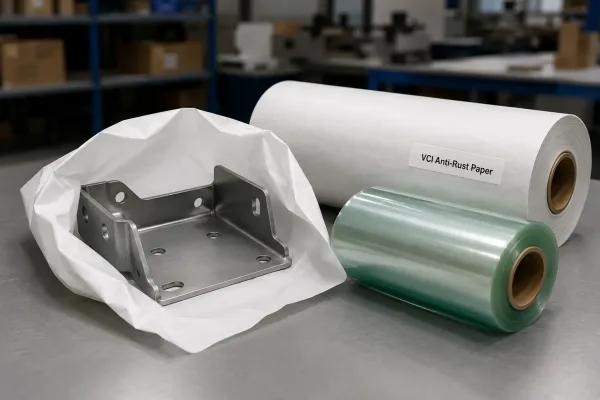
This image shows VCI paper and VCI poly film used for wrapping sheet metal parts. A bracket is partially unwrapped to demonstrate how VCI materials enclose and protect metal surfaces from corrosion.
They work without direct contact — the vapor fills the enclosed space and protects all exposed surfaces, including recessed areas and internal cavities.
VCI is the standard choice for:
- medium- to long-term storage
- parts that will not be immediately unpacked and used
Desiccant Packs in Sealed Bags or Containers
Desiccants — typically silica gel or montmorillonite clay — absorb moisture trapped inside the package at packing time.
They do not actively protect against moisture that enters after sealing, so they depend on a good moisture barrier, such as a sealed poly bag or shrink wrap, to be effective.
Desiccants are a practical choice for:
- short-term storage
- low-risk parts where VCI is unnecessary
Aluminum Barrier Foil with Desiccant
For high-risk parts on long ocean transits or extended warehouse storage, aluminum foil laminate provides the lowest water vapor transmission rate of any common packaging material.
Combined with desiccant and vacuum sealing, this approach creates a dry, isolated environment that can protect bare steel for a year or more.
It is the most expensive option, but for high-value parts or harsh transit routes, the cost is justified.
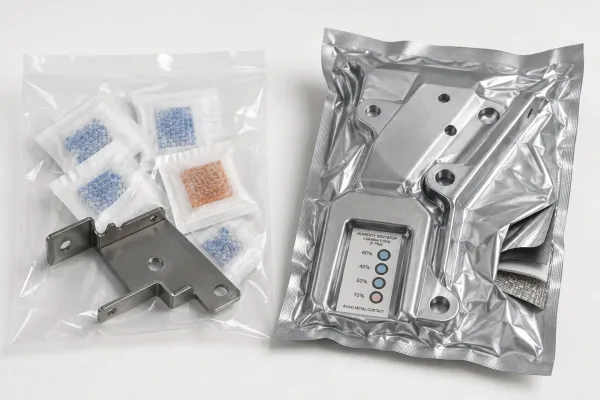
This image shows two moisture protection methods side by side: silica gel desiccant packs inside a sealed poly bag (left) and a vacuum-sealed aluminum barrier foil bag (right) with a humidity indicator card visible inside.
In practice, many shipments use a combination — for example:
- VCI paper wrapped around individual parts
- desiccant packs between layers
- a sealed outer bag as the moisture barrier
The key is matching the protection level to the risk, not defaulting to the cheapest or the most expensive option.
Steuerung der Lager- und Versandumgebung
Packaging protects parts during the time they are sealed.
But between the moment a box leaves the factory and the moment it reaches the assembly line, it passes through environments that can undermine even good packaging.
Warehouse Storage

This image shows best practices for warehouse storage of sheet metal parts: cartons on wooden pallets elevated off the concrete floor, dehumidifier unit, good ventilation, and clean dry conditions.
Parts should be stored in a dry, ventilated warehouse — ideally below 60% relative humidity.
Place pallets or skids on the floor rather than setting cartons directly on concrete, which wicks ground moisture upward.
Avoid storing near:
- open dock doors
- steam pipes
- areas with frequent temperature swings that cause condensation inside packaging
Shipping Containers
Ocean freight containers are not airtight.
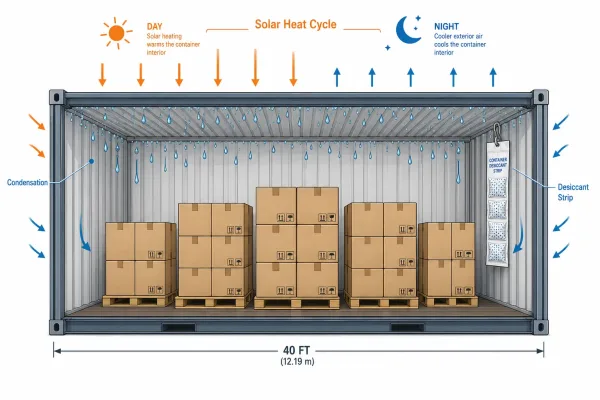
This diagram shows the “container rain” effect inside an ocean freight container, where temperature swings cause moisture to condense on the ceiling and drip onto cargo below. A container desiccant strip is shown as one mitigation method.
During a typical voyage, the container walls heat and cool with the sun, creating a “container rain” effect — moisture condenses on the ceiling and drips onto cargo.
To mitigate this:
- use container desiccant strips hung from the container walls
- ensure cargo is wrapped rather than loose
- avoid mixing sheet metal parts with moisture-generating cargo such as wet lumber or freshly painted goods
Transit Handling
Cartons should not be left on the tarmac or dock in rain or direct sun.
Waterproof outer wrapping or shrink wrap adds a layer of protection for the loading and unloading phases.
Für less-than-container-load (LCL) shipments that pass through multiple warehouses, the risk of exposure increases — and so does the need for robust inner packaging.
Überprüfung des Feuchtigkeitsschutzes — Inspektion und Überwachung
Installing moisture protection is not the same as confirming it works.
Without verification, you are relying on assumptions — and assumptions do not hold up in a container crossing the equator in July.
Humidity Indicator Cards
Humidity indicator cards are the simplest verification tool.
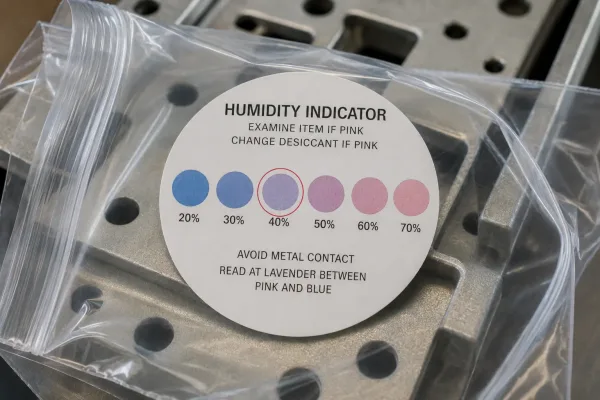
This image shows a humidity indicator card placed inside a sealed package. The color-change dots indicate whether humidity levels remained within safe thresholds during storage and transit, with the 40% dot showing the threshold was exceeded.
Placed inside the sealed package, they change color if moisture levels exceed a threshold, typically:
- 30% relative humidity
- 40% relative humidity
- 50% relative humidity
When the receiving team opens a shipment, the card provides an immediate, visible record of whether the package stayed dry.
If the card shows elevated humidity, the parts need inspection even if they look acceptable.
Data Loggers
For longer storage periods or higher-value shipments, consider adding a data logger inside the package or container.
These devices record temperature and humidity at set intervals, creating a time-stamped history that can pinpoint where and when conditions deteriorated.
This is especially useful for diagnosing recurring corrosion problems — the data often reveals that damage occurs not during ocean transit but during a two-week sit in an unventilated port warehouse.
Incoming Surface Inspection
At the receiving end, make surface inspection part of your Wareneingangsprüfstandards.
Check high-risk areas on a sampling basis:
- edges
- bend radii
- fastener holes
- scratched coating spots
- thin coating spots
Catching corrosion early means you can address it before parts reach the assembly line, where the cost of delay multiplies.
So nutzen Sie diese Checkliste in Ihrer Lieferantenbewertung
The checklist above is most effective when it is not just a reference document but a requirement embedded in your procurement process.
If you source sheet metal parts from an overseas manufacturer, the time to define moisture protection standards is before the first order — not after the first corroded shipment.
Include Requirements in RFQ Documents
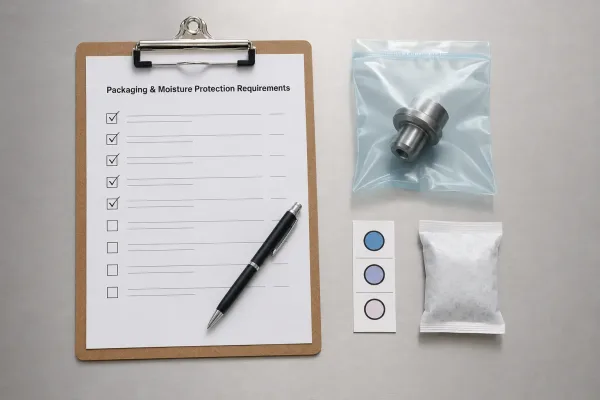
This image shows a packaging and moisture protection requirements checklist for supplier evaluation, accompanied by the key protection items: a VCI-sealed part, a humidity indicator card, and a desiccant pack.
Include packaging, moisture protection, and applicable Anforderungen an die Oberflächenbeschaffenheit in your RFQ documents.
Specify:
- the surface finish
- the expected storage duration
- the transit conditions
- whether VCI protection is required
- what type of desiccant should be used
- whether humidity indicator cards must be included
If your parts will pass through tropical climates or extended port holds, say so explicitly — your supplier cannot protect against conditions they do not know about.
Check the Process During Supplier Audits
During supplier audits, ask to see the supplier’s Qualitätskontroll- und Inspektionsprozess, including how pre-shipment checks are actually performed.
Confirm that:
- parts are handled with gloves after finishing
- surface pretreatment and cleaning remove residue
- packaging is done in a dry environment
These are small operational details, but they are the difference between parts that arrive ready to assemble and parts that arrive needing rework.
A supplier who treats moisture protection as a standard operating procedure — not an afterthought — is a supplier who understands what it costs you when things go wrong.