
YSie haben “matte Oberfläche” zu einem Zeichnungseintrag hinzugefügt. Der Lieferant antwortet und fragt nach einem Oberflächenrauheitswert. Jetzt müssen Sie entscheiden: Welcher Ra-Bereich tatsächlich als matt gilt und welches Fertigungsverfahren Sie dorthin bringt?
Matte Oberfläche beschreibt eine Oberfläche mit geringer gerichteter Reflexion — Licht wird breit gestreut, anstatt in einem einzigen Winkel zurückgeworfen zu werden. Anders als eine spiegelpolierte oder hochglänzende Oberfläche streut eine matte Oberfläche das Licht und erzeugt ein gleichmäßiges, nicht reflektierendes Erscheinungsbild. Der Begriff ist in der Fertigung weit verbreitet, aber er ist nicht selbsterklärend. Ohne einen messbaren Parameter wie Oberflächenrauheit (Ra) oder Glanzeinheiten (GU) lässt “matte Oberfläche” zu viel Spielraum für Interpretationen.
Was ist eine matte Oberfläche?
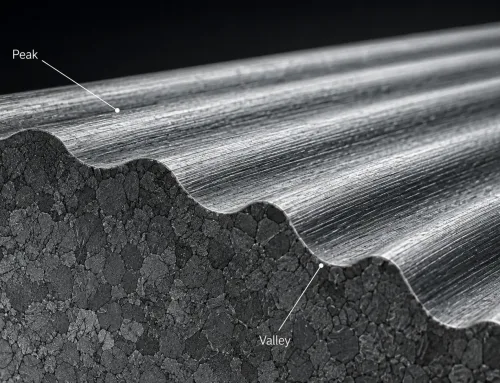
Eine matte Oberfläche ist jede Oberflächenbehandlung, die die gerichtete Reflexion auf ein niedriges, gleichmäßiges Niveau reduziert. Die Mikrorauheit der Oberfläche reicht aus, um einfallendes Licht über einen weiten Winkel zu streuen, anstatt es zum Betrachter zurückzuwerfen. Dies verleiht matten Oberflächen ihr charakteristisches weiches, flaches Erscheinungsbild.
Glanzstufen und wo Matt einzuordnen ist
Oberflächen von Blech werden oft entlang eines Glanzkontinuums beschrieben. An einem Ende reflektiert eine hochglänzende Oberfläche das Licht scharf — man denke an polierten Edelstahl oder Verchromung. Am anderen Ende absorbiert und streut eine flache oder matte Oberfläche nahezu das gesamte einfallende Licht. Die Industriekonvention unterteilt das Kontinuum im Allgemeinen in diese Kategorien:
- Hochglanz: >70 GU bei 60° — spiegelartige Reflexion
- Halbglanz: 35–70 GU bei 60° — merkliche Reflexion, weiche Kanten
- Satin: 15–35 GU bei 60° — leichter Schimmer, diffuse Reflexion
- Matt: <10 GU bei 60° — minimale bis keine sichtbare Reflexion
- Flach: <5 GU bei 60° — praktisch keine Reflexion
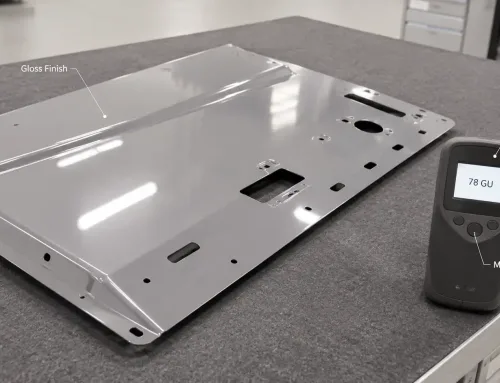
Glanzeinheiten werden mit einem Glanzmessgerät unter einem Standardwinkel (typischerweise 60°) gemessen. Die Schwelle zwischen “Satin” und “Matt” variiert je nach Branche und Anwendung, aber eine Oberfläche unter 10 GU bei 60° wird allgemein als matt anerkannt.
Matt vs. Satin vs. Glänzend: Was ist der Unterschied?
Die drei Begriffe beschreiben Punkte auf demselben Spektrum — sie unterscheiden sich darin, wie viel Licht die Oberfläche zur Quelle zurückwirft.
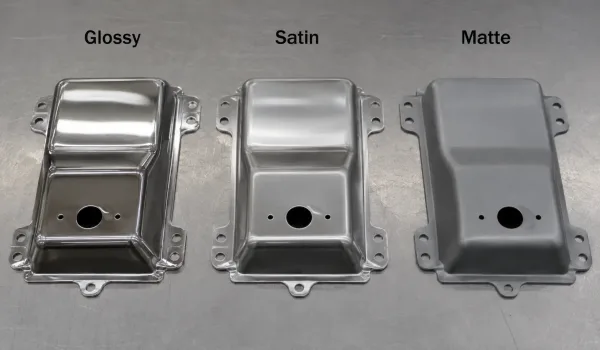
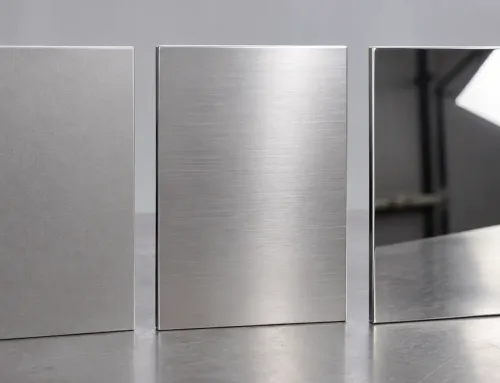
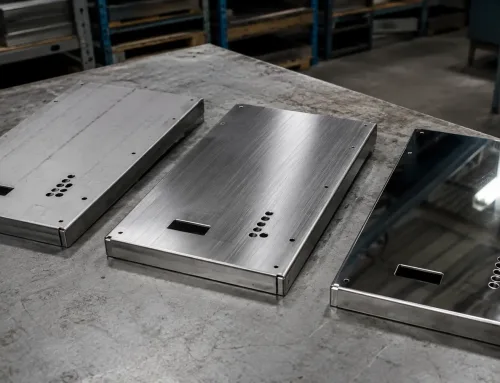
Ein direkter Vergleich von matten, satinierten und glänzenden Oberflächen, der zeigt, wie sich die Oberflächenreflexion auf das visuelle Erscheinungsbild auswirkt.
A glänzende Oberfläche ist glatt und hochreflektierend. Die Oberflächenrauheit ist sehr gering (typischerweise Ra < 0,4 μm), und die Reflexion ist gerichtet — man kann ein klares Bild in der Oberfläche sehen. Glänzende Oberflächen sind üblich bei Zierleisten, Gehäusen von Unterhaltungselektronik und polierten bearbeiteten Teilen.
A satinierte Oberfläche liegt zwischen glänzend und matt. Sie hat einen sichtbaren Schimmer, aber die Reflexion ist weicher und diffuser. Satinierte Oberflächen werden oft durch leichtes Kugelstrahlen, leichtes chemisches Ätzen oder Satin-Eloxieren erzielt. Die Oberflächenrauheit liegt typischerweise im Bereich von Ra 0,4–1,6 μm.
A matt Oberfläche hat minimale gerichtete Reflexion. Die Oberflächentextur ist rau genug, um Licht breit zu streuen, was ein flaches, gleichmäßiges Erscheinungsbild ohne sichtbare Bildreflexion erzeugt. Matte Oberflächen werden erzielt durch Kugelstrahlen, matte Pulverbeschichtung, mattes Eloxieren oder chemisches Ätzen.
Glanzeinheiten und visuelles Erscheinungsbild
| Oberfläche | Glanzeinheiten (60°) | Visuelles Erscheinungsbild | Typical Ra Range |
|---|---|---|---|
| High gloss | >70 GU | Mirror-like, sharp reflection | < 0.4 μm |
| Semi-gloss | 35–70 GU | Noticeable reflection, softened | 0.4–1.0 μm |
| Satin | 15–35 GU | Soft sheen, diffused light | 0.4–1.6 μm |
| Matt | <10 GU | Flat, no visible reflection | 1.6–6.3 μm |
| Flat | <5 GU | Dead flat, absorbs light | > 6.3 μm |
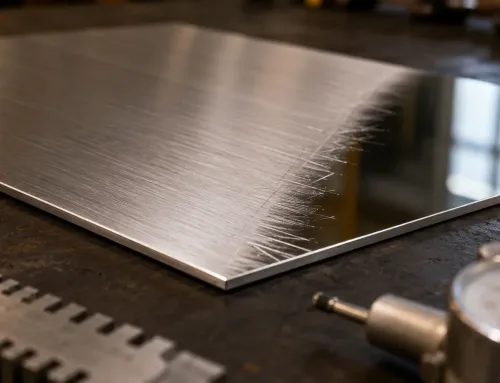
Keep in mind that gloss units and Ra measure different things. Gloss units quantify optical reflectivity; surface roughness (Ra) quantifies the average height variation of the surface profile. A surface can have the same Ra but different gloss levels depending on the texture pattern — a directional brushed surface at Ra 1.6 μm will look different from a blasted surface at the same Ra.
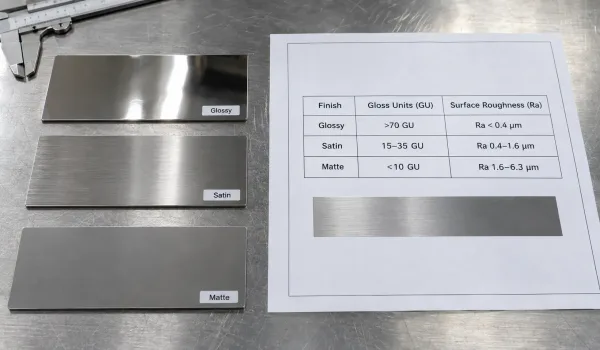
A technical reference showing how gloss units and Ra ranges relate to glossy, satin, and matte metal finishes.
Welcher Ra-Wert entspricht einer matten Oberfläche?
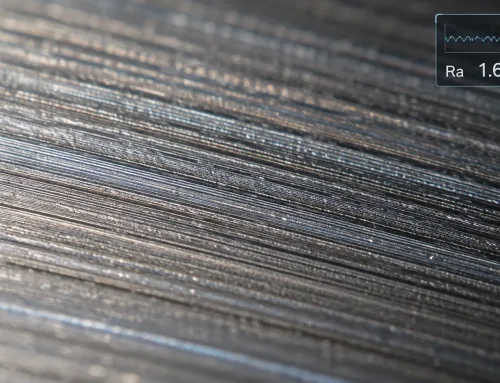
There is no single Ra value that defines “matte.” The relationship between Ra and visual appearance depends on the manufacturing process, material, and surface texture pattern. However, most matte surfaces produced through common manufacturing processes fall within a predictable range.
As a general reference:
- Bead-blasted matte: Ra 1.6–6.3 μm — the most common matte finish on sheet metal and machined parts
- Matte powder coating: Ra 1.6–3.2 μm (surface profile of the cured coating)
- Matte anodizing: Ra 0.8–3.2 μm (depends on the pre-treatment etch)
- Chemical matte etch: Ra 0.8–1.6 μm — finer matte, often on aluminum
These ranges are approximate. A blasted surface at Ra 3.2 μm on stainless steel will appear more matte than the same Ra value on aluminum, because the material’s reflectivity affects the perceived gloss. For critical applications, specify both the Ra value and the gloss unit requirement to eliminate ambiguity.
Wie man eine matte Oberfläche auf Blech und bearbeiteten Teilen erzielt
The manufacturing process you choose affects the surface texture, appearance consistency, cost, and material compatibility. Here are the four most common methods for producing a matte finish on metal parts.
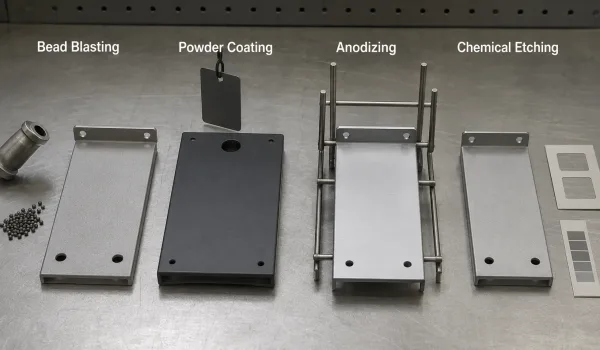
A comparison of bead blasting, matte powder coating, anodizing, and chemical etching used to create matte finishes on metal parts.
Kugelstrahlen
Bead blasting (also called sandblasting or abrasive blasting) propels fine media — glass beads, aluminum oxide, or ceramic particles — at the surface under compressed air. The impact creates a uniform dimpled texture that scatters light.
- Typical Ra: 1.6–6.3 μm, adjustable by media size and pressure
- Materialien: Nearly all metals — steel, stainless steel, aluminum, titanium, copper
- Advantages: Fast, cost-effective, produces a consistent matte appearance across complex geometries
- Einschränkungen: Does not add a protective coating; the bare metal surface remains exposed and may require a sealant or additional coating for corrosion protection. Blasting can also slightly reduce dimensional accuracy on tight-tolerance features.
Powder Coating (Matte Formulation)
Matte powder coating applies a dry polymer powder to the surface electrostatically, then cures it in an oven. Matte powder formulations contain texturing agents that produce a low-gloss finish without additional surface preparation.
- Typical Ra: 1.6–3.2 μm (coating surface profile)
- Materialien: Steel, stainless steel, aluminum — any substrate that can withstand curing temperature (typically 160–200°C)
- Advantages: Combines matte appearance with corrosion protection and abrasion resistance in a single step. Wide color selection.
- Einschränkungen: Adds a coating thickness of 60–120 μm, which affects dimensional tolerances. Not suitable for parts with tight assembly fits. Edges and weld seams may show coating inconsistencies.
Anodizing (Matte / Satin Anodize)
Der matte anodizing process grows a controlled oxide layer on aluminum through an electrochemical process. A matte finish is achieved by etching the surface before or during anodizing — either through chemical etching (alkaline bath) or by adjusting the anodizing parameters.
- Typical Ra: 0.8–3.2 μm, depending on etch duration and alloy
- Materialien: Aluminum alloys only (6061, 5052, 7075, etc.)
- Advantages: Hard, wear-resistant surface; excellent corrosion protection; maintains dimensional accuracy better than powder coating because the oxide layer is thinner (5–25 μm for Type II)
- Einschränkungen: Aluminum only. Color consistency can vary between alloy batches and heat treatment states. Matte anodizing on 7075 may produce a different visual result than on 6061.
Chemical Etching / Conversion Coating
Chemical etching uses acidic or alkaline solutions to selectively dissolve the surface, creating a micro-rough texture. Conversion coatings (such as chromate or phosphate) can also produce a matte appearance while adding corrosion resistance.
- Typical Ra: 0.8–1.6 μm
- Materialien: Aluminum, steel, zinc alloys
- Advantages: Can be applied to complex geometries without mechanical contact. Good for parts that cannot tolerate blasting forces (thin walls, delicate features).
- Einschränkungen: Chemical process requires waste treatment and environmental compliance. The matte effect is subtle — more of a satin-to-matte range — and less uniform than blasting on large flat surfaces.
Wie man eine matte Oberfläche in technischen Zeichnungen spezifiziert
A drawing callout that says only “matte finish” is ambiguous. Different suppliers may interpret it differently, leading to inconsistent parts or delays from clarification requests. Specify matte finish using measurable parameters.
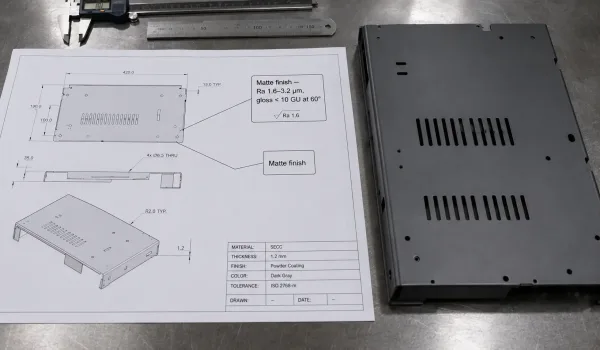
An engineering drawing showing how to specify a matte finish using Ra and gloss unit requirements.
Using Ra Values
The most precise approach is to call out the surface roughness directly:
- Format: Ra X.X μm (or Ra X μin) with a surface roughness symbol per ISO 1302 or ASME Y14.36
- Example: Ra 3.2 μm (√ symbol) on all exterior surfaces
- Why it works: Ra is a universally understood parameter. Any qualified manufacturer can measure and verify it.
Jedoch, Ra alone does not fully describe a matte appearance. Two surfaces with the same Ra can look different if the texture patterns differ (directional vs. isotropic).
Using Gloss Units
For appearance-critical parts, define measurable acceptance criteria by adding a gloss unit requirement alongside the Ra value:
- Format: “Matte finish — Ra 1.6–3.2 μm, gloss < 10 GU at 60°”
- Why it works: This defines both the surface texture and the optical result. It prevents the case where a surface meets the Ra spec but does not look matte.
Common Annotation Mistakes
- Specifying only “matte finish” with no Ra or GU value — leaves the interpretation to the supplier
- Specifying a very tight Ra range (e.g., Ra 1.6 ± 0.2 μm) — may not be achievable with all matte processes, especially bead blasting
- Not specifying the measurement location — Ra can vary across a part, especially near edges, welds, or formed areas
- Confusing matte with satin — if you want no visible sheen, specify Ra > 1.6 μm and < 10 GU; if a slight sheen is acceptable, specify Ra 0.8–1.6 μm
Wann sollte man eine matte Oberfläche wählen?
Matte finishes are a practical choice when the part needs to reduce glare, hide surface imperfections, or improve coating adhesion. Typische Anwendungen umfassen:
- Enclosures and housings — reduces glare in lighting-sensitive environments (medical devices, industrial control panels, military equipment)
- Outdoor equipment — matte surfaces show fewer water spots and fingerprints than glossy surfaces
- Parts that will be painted or powder coated — a matte base surface improves mechanical adhesion of subsequent coatings
- Consumer-facing products — matte finishes convey a premium, understated aesthetic common in electronics, appliances, and automotive trim
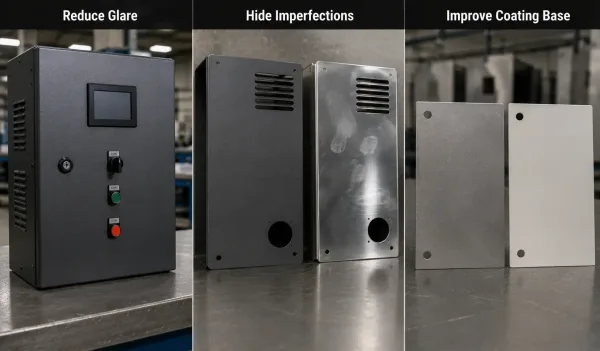
Typical applications where matte finish is chosen to reduce glare, hide marks, or support coating performance.
If the part requires a reflective surface (mirror, optical housing, decorative chrome), matte is the wrong choice. If the part is a sealing surface or requires low friction for moving contact, a matte texture may increase friction or prevent proper sealing — consult the mating part requirements before specifying.
Einschränkungen und Kompromisse bei matten Oberflächen
Matte finishes are not without trade-offs:
- Harder to clean — the micro-rough texture that produces the matte appearance also traps dirt, oils, and fingerprints more readily than a smooth glossy surface. In food-contact or cleanroom applications, this may be a concern.
- Not all processes produce the same result — bead blasting creates an isotropic texture; chemical etching may leave a directional pattern. The visual appearance can differ even when Ra values are similar.
- Added cost for some processes — matte powder coating and matte anodizing may carry a slight cost premium over standard formulations, depending on the supplier’s inventory and process capabilities.
- Dimensional impact — powder coating adds 60–120 μm per side. If your part has tight assembly tolerances, account for the coating thickness in your design.