
MDie Materialverfügbarkeit klingt nach einer einfachen Frage: Ist das Material auf Lager oder nicht? In der kundenspezifischen Fertigung ist das selten so einfach. Ein Lieferant kann reichlich Stahl vorrätig haben und trotzdem nicht die exakte Materialgüte, Dicke oder Oberfläche beschaffen, die Ihre Zeichnung erfordert.Die Verfügbarkeit ist keine binäre Bedingung — sie ist eine Variable, die geprägt wird durch Materialauswahl, Spezifikationsgenauigkeit, Bestellmenge und die Tiefe der Lieferkette für ein bestimmtes Produkt.
Das Verständnis dieser Variablen ist wichtig, weil die Materialverfügbarkeit direkt die Durchlaufzeit, die Kosten und die Termintreue eines Projekts beeinflusst. Ein einfach zu fertigendes Teil kann sich dennoch um Wochen verzögern, wenn das spezifizierte Material schwer zu beschaffen ist.
Was ist Materialverfügbarkeit?
Materialverfügbarkeit bezeichnet, ob ein bestimmtes Material — in der erforderlichen Güte, Form, Größe und Beschaffenheit — innerhalb eines angemessenen Zeitrahmens und zu vorhersehbaren Kosten von einem Lieferanten bezogen werden kann. Bei der Beschaffung kundenspezifischer Teile bedeutet dies, dass der Rohstoff, der für die Herstellung Ihrer Komponenten benötigt wird, verfügbar ist, wenn die Produktion beginnen soll.
Der Begriff wird manchmal mit verwandten Konzepten verwechselt:
- Lagerverfügbarkeit bezieht sich darauf, was ein bestimmter Lieferant derzeit auf Lager hat. Materialverfügbarkeit ist weiter gefasst — sie umfasst, was bei Distributoren, Hüttenwerken oder Sekundärquellen bestellt werden kann.
- Produktverfügbarkeit beschreibt in der Regel fertige Waren, die zum Kauf bereitstehen. Materialverfügbarkeit betrifft Roh- oder Halbfertigprodukte, die in der Fertigung verwendet werden.
Für Beschaffungsteams ist die Unterscheidung wichtig. Ein Lieferant ohne Stahl auf Lager kann ihn möglicherweise dennoch innerhalb weniger Tage beschaffen, wenn es sich um eine gängige Güte handelt. Umgekehrt hat ein Lieferant mit Stahl auf Lager möglicherweise nicht die exakte Spezifikation, die Ihre Zeichnung erfordert. Materialverfügbarkeit ist letztlich eine Frage der Lieferkettentiefe für eine bestimmte Spezifikation, nicht nur des Lagerbestands.
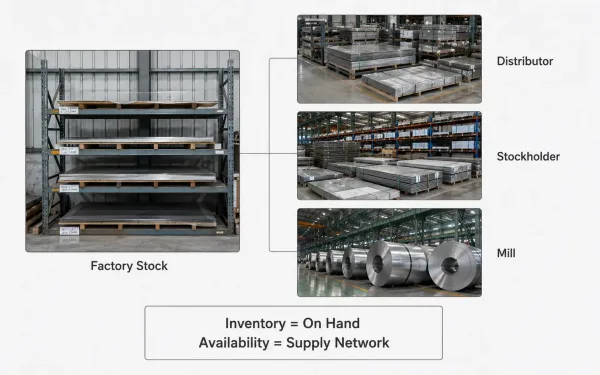
Ein einfaches Beschaffungsdiagramm, das den Unterschied zwischen Werksbestand und der Verfügbarkeit in der weiteren Materiallieferkette zeigt.
Was die Materialverfügbarkeit in der kundenspezifischen Fertigung beeinflusst
Mehrere Variablen bestimmen, wie einfach ein Lieferant das für Ihre Teile erforderliche Material beschaffen kann. Keine davon wirkt isoliert — sie interagieren auf eine Weise, die Verzögerungen verstärken oder, bei gutem Management, Projekte auf Kurs halten kann.
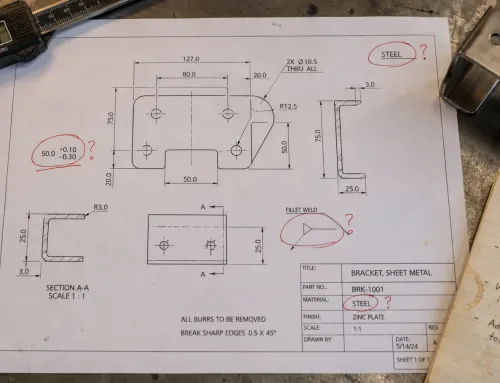
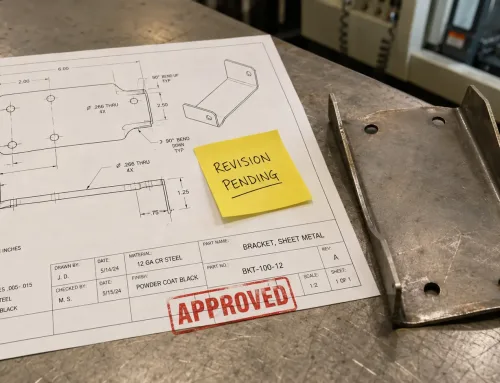
Spezifikationsgenauigkeit auf der Zeichnung ist oft der unmittelbarste Faktor. Eine Zeichnung, die “Edelstahlblech” verlangt, gibt dem Lieferanten die Flexibilität, die am leichtesten verfügbare Güte und Dicke zu beschaffen. Eine Zeichnung, die “ASTM A240 Type 304, 2B-Oberfläche, 16 Gauge (0,0598 in.), gemäß AMS 2700 Passivierung” spezifiziert, schränkt die Suche auf ein sehr spezifisches Produkt ein. Beide Ansätze sind gültig — das richtige Maß an Genauigkeit hängt von der Funktion des Teils ab — aber je enger die Spezifikation, desto weniger Quellen können sie liefern.
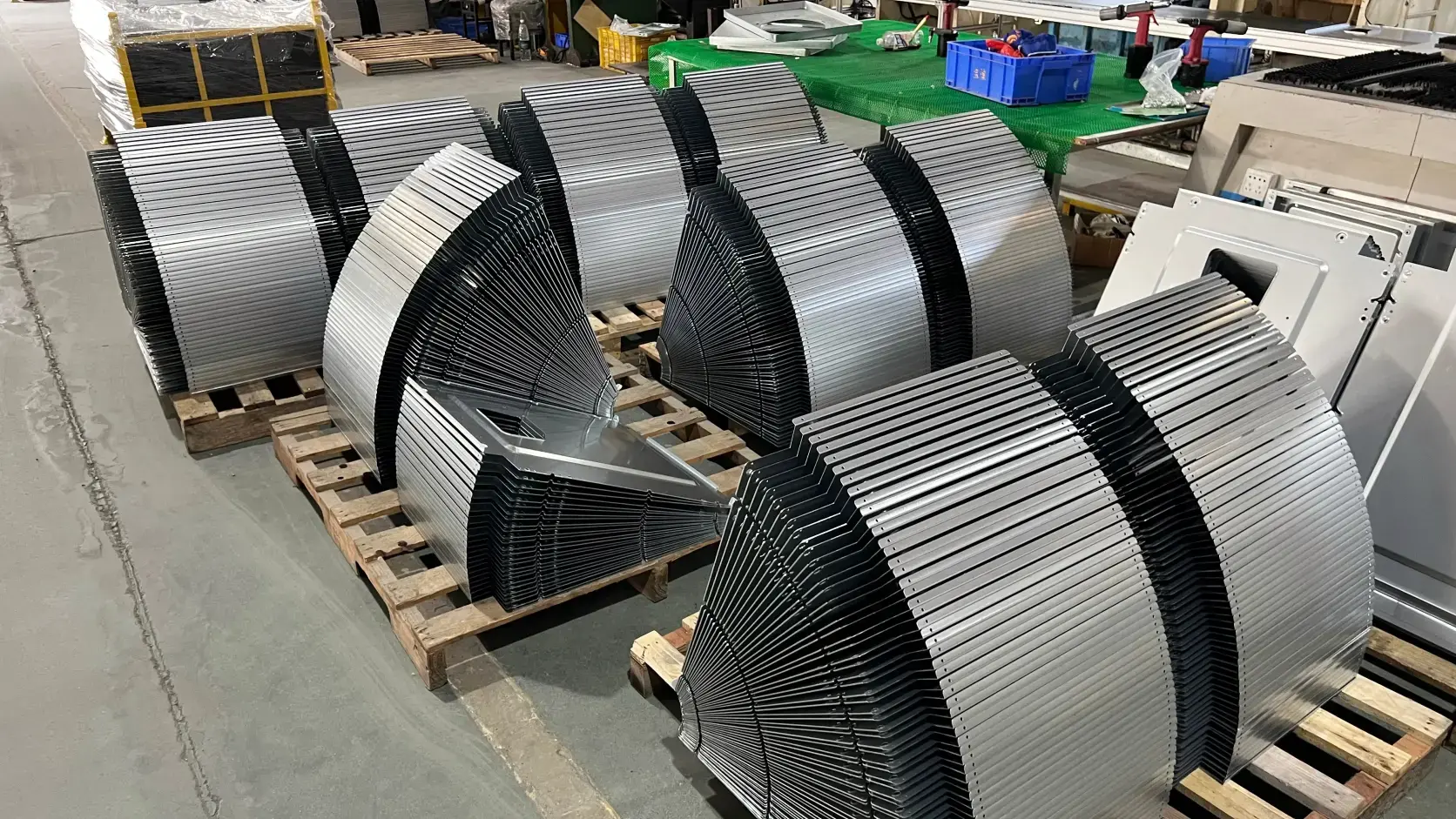
Bestellmenge schafft eine andere Art von Einschränkung. Materiallieferanten und Distributoren legen Mindestbestellmengen (MOQs), fest, oft gemessen in vollen Blechen oder Standardzuschnitten. Ein Projekt, das 10 Teile aus einem einzigen Aluminiumblech erfordert, benötigt möglicherweise nur ein Blech, was gut innerhalb typischer Einkaufsmengen liegt. Ein Projekt, das 500 Teile aus einer Speziallegierung erfordert, kann eine Hüttenbestellung mit Durchlaufzeiten in Monaten statt Tagen.
erfordern. Lieferkettentiefe variiert erheblich je nach Materialtyp. Gängige Güten von kaltgewalztem Stahl, verzinktem Stahl und 6061-Aluminium haben tiefe Lieferketten mit mehreren Distributoren, die Standardgrößen in den meisten Industrieregionen lagern. Speziallegierungen — bestimmte Kupfergüten, Titan oder hochnickelhaltige Legierungen — haben möglicherweise nur eine Handvoll inländischer Quellen, mit Durchlaufzeiten, die je nach Nachfrage aus der Luft- und Raumfahrt-, Medizin- oder Energiebranche schwanken.
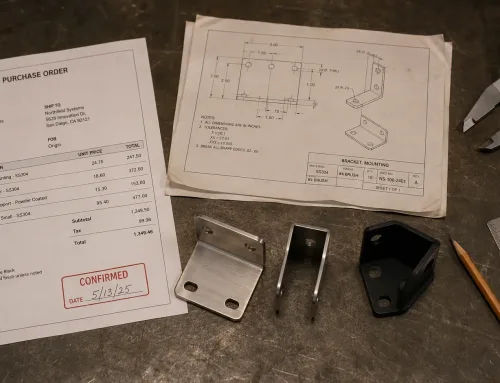
Oberflächenbehandlung und Weiterverarbeitung fügen eine weitere Ebene hinzu. Ein Rohblech aus CRS (kaltgewalztem Stahl) ist möglicherweise innerhalb weniger Tage verfügbar. Dasselbe Blech mit einer bestimmten Pulverbeschichtungsfarbe, eloxierter Oberfläche oder chemischer Vernickelung bringt zusätzliche Beschaffungsanforderungen mit sich — das Beschichtungsmaterial, die Kapazität des Veredelungsanbieters und die Kompatibilität der Oberfläche mit dem Grundmaterial werden alle zu Variablen in der Verfügbarkeitsgleichung.
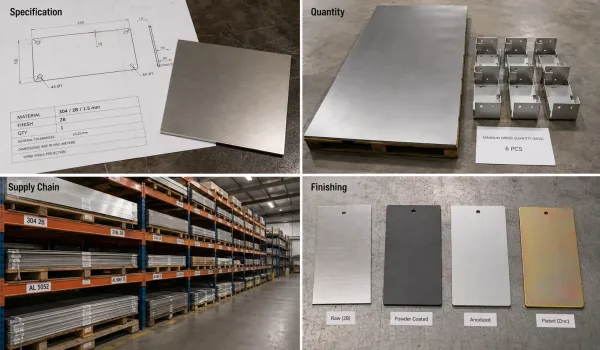
Vier Schlüsselfaktoren, die die Materialbeschaffung beeinflussen: Spezifikation, Menge, Lieferkettentiefe und Veredelungsanforderungen.
Wie die Materialauswahl die Verfügbarkeit beeinflusst
Das Material, das Sie in der Konstruktionsphase auswählen, hat einen direkten und messbaren Einfluss darauf, wie schnell ein Lieferant mit der Produktion beginnen kann. Dieser Einfluss ist nicht immer offensichtlich, weil die Materialauswahl in der Regel von mechanischen Anforderungen — Festigkeit, Korrosionsbeständigkeit, Gewicht — und nicht von Lieferkettenüberlegungen bestimmt wird.
Gängige Baustähle such as ASTM A36, AISI 1018, and AISI 1045 are among the most readily available materials in sheet and plate form. Distributors stock standard sizes in most industrial markets, and secondary suppliers maintain inventories of common thicknesses from 0.030 in. to 1.000 in. Lead times for these materials are typically measured in days.
Stainless steels — particularly 304 and 316 grades — are widely available in standard sheet sizes, though the range of surface finishes (2B, No. 4, mirror, BA) varies by supplier. Specialty stainless grades such as 17-4 PH or duplex alloys are available from fewer sources and may require minimum orders or extended lead times.
Aluminum alloys follow a similar pattern. 6061-T6 aluminum and 5052-H32 are stocked by most aluminum distributors in standard sheet and plate sizes. Less common alloys — 2024, 7075, or cast plate — may require longer lead times or minimum purchase commitments.
Copper and brass present a more constrained picture. While C110 copper sheet is available from major distributors, the range of stocked thicknesses and widths is narrower than steel or aluminum. Certain copper alloys used in electrical applications may require mill orders.
Titanium and high-performance alloys sit at the far end of the availability spectrum. Sheet titanium in Grade 2 or Grade 5 may be available from specialty distributors, but standard sizes are limited, and prices fluctuate more than common metals.
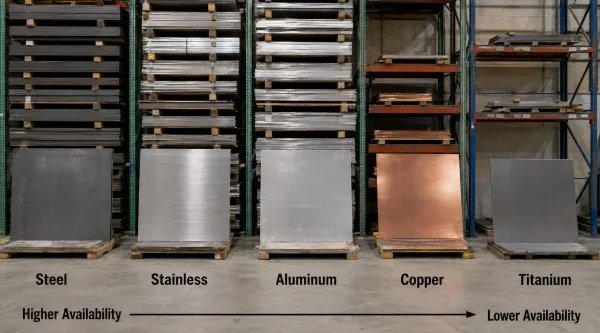
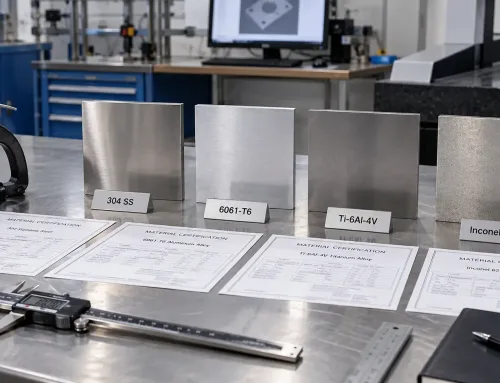
Common steel, stainless steel, aluminum, copper, and titanium shown with different levels of typical material availability.
When a specified material proves difficult to source, suppliers may be able to suggest an equivalent or near-equivalent substitute. A design that calls for 303 stainless steel — a free-machining grade — could potentially use 304 stainless if machinability is not the critical requirement. The key is for the drawing to either lock down the specific grade or explicitly allow alternatives.
Wie Zeichnungsspezifikationen die Materialbeschaffung beeinflussen
The way a material is called out on a drawing does more than define a requirement — it determines how many potential sources can supply it. Engineers and designers who understand this relationship can write specifications that are both precise enough for quality control and flexible enough for sourcing.
A specification like “aluminum sheet, 0.063 in., 6061-T6” is clear, functional, and easy for a supplier to source from multiple distributors. It does not tie the material to a particular standard body or mill source. For many applications — brackets, enclosures, covers — this level of specification is entirely adequate.
A specification like “aluminum sheet per AMS-QQ-A-250/11, 0.063 in. nominal, 6061-T6, bare, per MIL-DTL-5541 Type I Class 3 chromate conversion coating” is significantly more precise. It locks the material to an aerospace specification, defines the temper, and specifies the surface treatment. This is appropriate when the part must meet regulatory or customer-driven standards, but it limits sourcing to suppliers who can certify material to that specification and provide the required material certificate and documentation.
The trade-off is practical: higher specification precision generally means fewer qualified sources, longer lead times, and higher material costs. This does not mean specifications should be vague — it means they should be calibrated to the part’s actual requirements. A structural bracket in an industrial enclosure does not need the same material traceability as a flight-critical aerospace component.
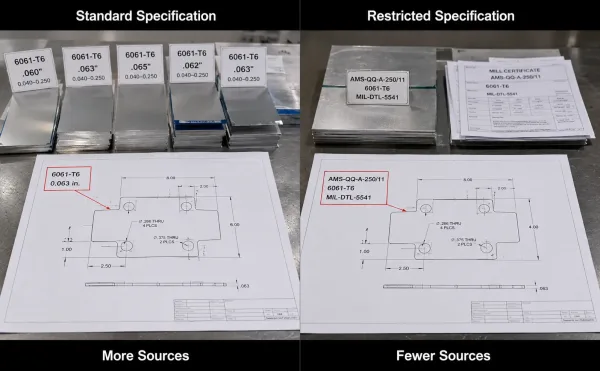
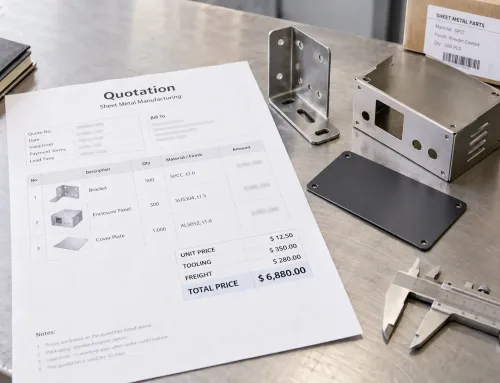
Two engineering material specifications showing how tighter requirements can reduce sourcing flexibility.
For procurement teams, one of the most effective steps is to review material callouts during the design phase, before drawings are released for quoting. Asking “is this specification as narrow as it needs to be, but no narrower?” can prevent sourcing delays downstream.
Materialverfügbarkeit für Kleinserienprojekte
Low-volume sheet metal fabrication projects — prototype runs and short production quantities of 5 to 50 pieces — face a distinct set of material availability challenges that differ from volume production.
Minimum order quantities are the most common constraint. A material distributor may sell aluminum sheet in full-sheet increments of 48 × 96 in. A project requiring only a few small parts from that sheet means the buyer is purchasing far more material than the parts require. For common materials, this may be acceptable — the excess can be used on future orders or the per-unit material cost remains manageable. For expensive alloys, the MOQ mismatch can make small-batch projects disproportionately costly.
Supplier remnant stock can be a practical solution. Many fabrication shops and material distributors maintain inventories of offcuts and remnants — pieces remaining from larger orders that are too small for volume work but more than sufficient for a handful of parts. Not all suppliers advertise remnant availability, so asking directly can uncover material that is both faster to obtain and less expensive than a full-sheet purchase.
Lead time sensitivity is amplified at small quantities. In volume production, a two-week material lead time is absorbed into a longer production schedule. In a small-batch project where the entire order may be completed in a few days, that same two-week lead time becomes the dominant factor in the delivery schedule. Confirming material availability before committing to a delivery date is particularly important for small-batch orders.
For procurement teams, the most practical step is to communicate batch size early in the quoting process. Suppliers who understand the quantity context can offer material options — including remnants, alternative grades, or stocked sizes — that may not appear in a standard material specification.
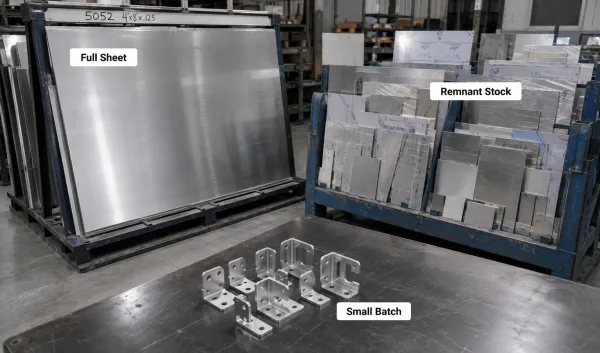
Full sheets, remnant stock, and small fabricated parts illustrating material sourcing options for low-volume orders.
So verbessern Sie die Materialverfügbarkeit für Ihre Aufträge
Improving material availability is less about finding better suppliers and more about making informed decisions earlier in the procurement cycle. The choices made at the design and specification stage have a disproportionate impact on whether materials can be sourced efficiently.
Start with common grades and standard sheet metal thicknesses when possible. A design that specifies 10-gauge CRS (0.1345 in.) will source more easily than one calling for 3.5 mm (0.1378 in.) — a thickness that exists in the metric system but does not correspond to a standard gauge or fractional inch size. Standard sizes are stocked by more distributors and are available with shorter lead times.
Allow flexibility where the design permits. If a part does not require a specific alloy for certification or performance reasons, the drawing can specify a material category rather than a single grade. “Stainless steel, austenitic, 300 series” gives the supplier room to source what is most available, while still defining the material family.
Confirm availability before finalizing the design. A brief check with the manufacturer or material supplier during the design phase — “is this material readily available in the quantity I need?” — can prevent delays that would otherwise surface weeks later during quoting or production.
Consider the total material pipeline. Material availability is not just about the raw sheet or bar — it includes any coatings, treatments, or secondary materials needed to complete the part. A design that specifies both a specialty alloy and a hard-to-source surface finish multiplies the sourcing challenge.
For most custom parts, the goal is not to minimize specification — it is to match specification to requirement. The right level of detail makes a part easier to source without compromising its fitness for use.
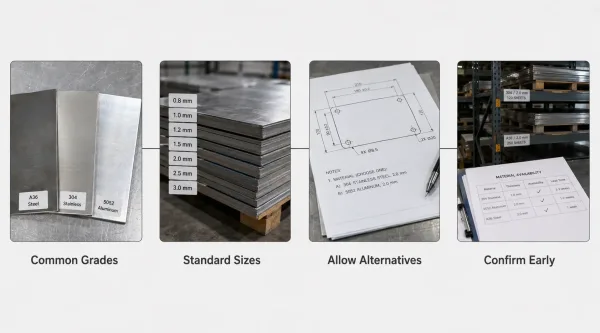
A practical material sourcing workflow using common grades, standard sizes, approved alternatives, and early availability checks.