
HPb59-1 Bleihaltiges Messing
Zerspanbarkeit
Verschleißleistung
Drehteile
Bohrbearbeitung
HPb59-1 Bleihaltiges Messing: Grundlegender Überblick
HPb59-1 ist eine bleihaltige Messingsorte, die unter der chinesischen Norm GB/T 5231 definiert ist. Ihre Bezeichnung folgt einer einfachen Namensregel: H steht für Messing, Pb steht für Blei, 59 gibt an, dass der Kupfergehalt etwa 59% beträgt, und 1 bedeutet, dass der Bleigehalt etwa 1% beträgt.
HPb59-1 ist ein alpha-plus-beta Zweiphasen-Messing. Die Zugabe von Blei verbessert die Zerspanbarkeit erheblich und behält gleichzeitig gute mechanische Eigenschaften und Korrosionsbeständigkeit bei.
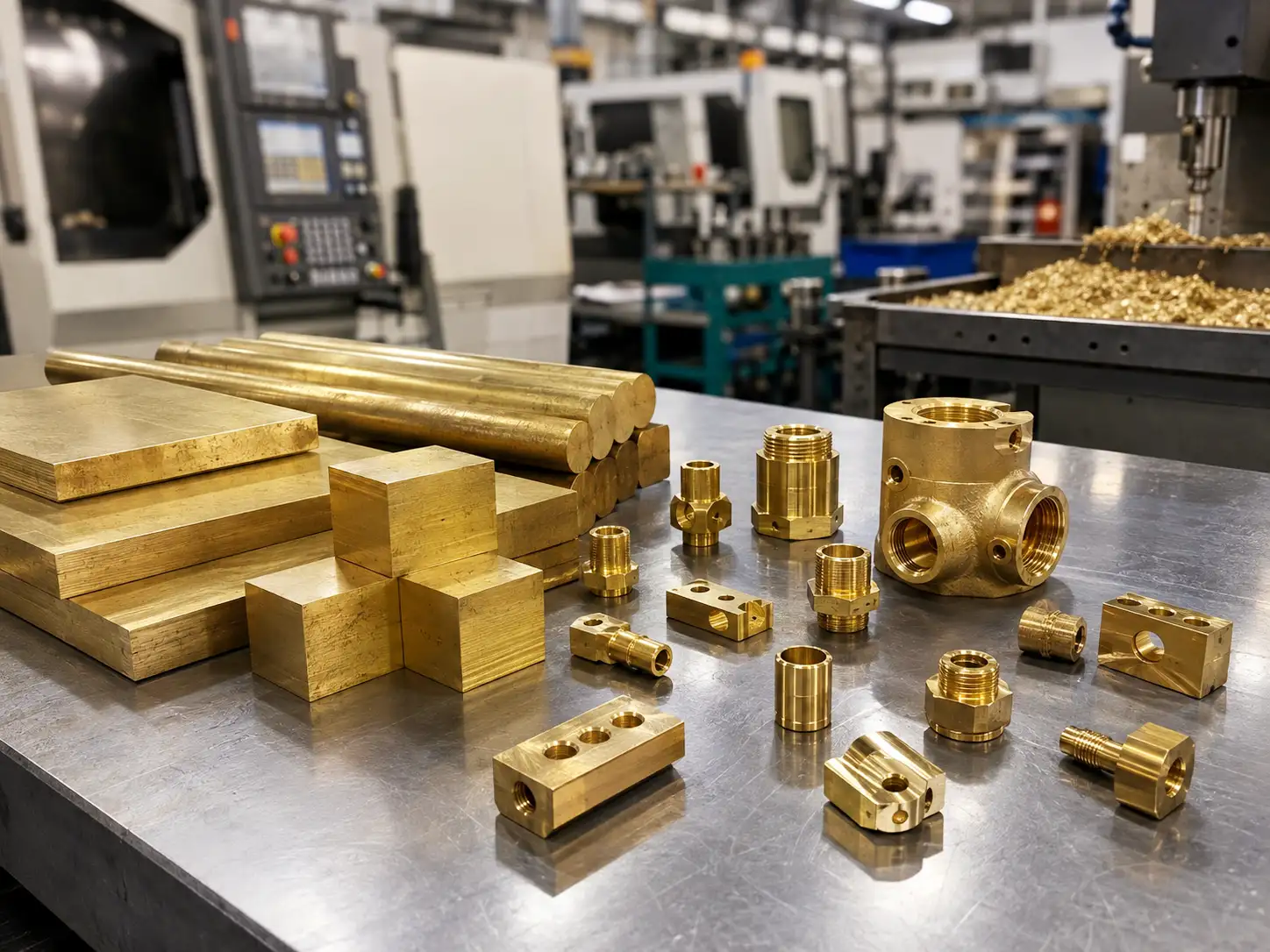
In industriellen Anwendungen wird HPb59-1 oft als Automatenmessing oder Freischnittmessing bezeichnet, und es ist ein äußerst vielseitiges Material in der Metallfertigung. Das Blei liegt als feine freie Partikel vor, die entlang der Korngrenzen verteilt sind. Während der Bearbeitung helfen diese Bleipartikel bei der Spanbrechung und Schmierung, was die Schneidleistung erheblich verbessert und den Werkzeugverschleiß reduziert.
Aus fertigungstechnischer Sicht eignet sich HPb59-1 besser für Teile, die primär für die Zerspanung entwickelt wurden. Wenn ein Projekt stark auf Umformstanzen mit großer Verformung, Tiefziehen oder Anwendungen mit hoher Nachgiebigkeit und Kontakt mit Wasser angewiesen ist, kann es besser sein, eine andere Kupferlegierung in Betracht zu ziehen, die für diese Anforderungen geeigneter ist.
Schnellidentifikationsleitfaden für HPb59-1
| Identifikationskategorie | Details | Hauptmerkmale |
|---|---|---|
| Chinesische Sorte | HPb59-1 | H = Messing, Pb = Blei, 59 ≈ Kupfergehalt %, 1 ≈ Bleigehalt % |
| Materialkategorie | Kupfer-Zink-Blei-Ternärlegierung | Alpha-plus-beta Zweiphasen-Messingstruktur |
| Kernvorteil | Automatenbearbeitung, hohe Effizienz | Schnittgeschwindigkeiten können 200 m/min überschreiten |
| Visuelles Erscheinungsbild | Goldgelber metallischer Glanz | Dichte etwa 8,5 g/cm³ |
| Normreferenz | GB/T 5231-2012 | Chinesische nationale Norm für Verarbeitungsmessing |
Spezifikationen von HPb59-1
Die chemische Zusammensetzung von HPb59-1 bleihaltigem Messing ist sorgfältig ausbalanciert, um die Zerspanbarkeit zu optimieren und gleichzeitig eine einwandfreie mechanische Leistung beizubehalten.
Kupfer dient als Basiselement und bildet die Grundlage für elektrische Leitfähigkeit, Wärmeleitfähigkeit und Korrosionsbeständigkeit. Zink trägt zur Mischkristallverfestigung bei. Blei ist das Schlüsselelement, das die Zerspanbarkeit verbessert. Andere Verunreinigungselemente wie Eisen, Aluminium und Phosphor müssen ebenfalls streng kontrolliert werden, um eine stabile Materialleistung zu gewährleisten.
HPb59-1 Spezifikationsübersicht
| Parameterkategorie | Parameter | Wertebereich | Hinweise |
|---|---|---|---|
| Chemische Zusammensetzung | Kupfer (Cu) | 57.0%–60.0% | Legierungsbasis, bietet die Grundlage für Korrosionsbeständigkeit |
| Blei (Pb) | 0.8%–1.9% | Schlüsselfunktionselement zur Verbesserung der Zerspanbarkeit | |
| Zink (Zn) | Rest, ca. 38%–41% | Bietet Mischkristallverfestigung und hilft, Festigkeit und Duktilität auszubalancieren | |
| Eisen (Fe) | ≤ 0,5% | Verunreinigungselement, Obergrenze kontrolliert | |
| Aluminium (Al) | ≤ 0,2% | Verunreinigungselement, Obergrenze kontrolliert | |
| Phosphor (P) | ≤ 0,02% | Verunreinigungselement, Obergrenze kontrolliert | |
| Gesamtverunreinigungen | ≤ 1,0% | Allgemeine Anforderung zur Verunreinigungskontrolle | |
| Physikalische Eigenschaften | Dichte | 8,5 g/cm³ | Unterstützt Leichtbau-Überlegungen |
| Elektrische Leitfähigkeit | Ca. 26% IACS | Besser als die meisten Stahlwerkstoffe | |
| Wärmeleitfähigkeit | 105–110 W/(m·K) | Geeignet für Wärmeableitungskomponenten | |
| Linearer Wärmeausdehnungskoeffizient | 20,5 × 10⁻⁶/°C (20–300°C) | Gute thermische Stabilität | |
| Schmelzpunkt | 900–930 °C | Typischer Gießfließbereich | |
| Mechanische Eigenschaften | Zugfestigkeit (σb) | 380–550 MPa | Abhängig von der Werkstoffzustandsart |
| Streckgrenze | 240–270 MPa | Mittleres Festigkeitsniveau | |
| Dehnung (δ) | 10%–25% | Gute Duktilität | |
| Brinellhärte (HB) | 75–130 | Abhängig vom Wärmebehandlungszustand | |
| Rockwellhärte (HRB) | 70–85 | Härteniveau nach der Bearbeitung | |
| Verarbeitungseigenschaften | Zerspanbarkeitsindex | 180%–210% | Basierend auf Automatenstahl = 100% |
| Oberflächenrauheit | Ra 1,6 μm erreichbar | Geeignet für präzisionsbearbeitete Oberflächenqualität | |
| Kaltverformung pro Durchgang | Bis zu 45% | Moderate Kaltumformbarkeit |
Gängige internationale Äquivalente für HPb59-1
HPb59-1 bleihaltiges Messing ist ein weit verbreitetes Automatenmessing mit entsprechenden Sorten in vielen Industriemärkten weltweit. Obwohl die Benennungssysteme je nach Land und Region variieren, sind Zusammensetzung und Leistung im Allgemeinen vergleichbar.
Gängige normübergreifende Referenzsorten für HPb59-1
| Land / Region | Normensystem | Referenzsorte | Zusammensetzungsvergleich | Anwendungshinweise |
|---|---|---|---|---|
| China | GB/T | HPb59-1 | Cu: 57%–60%, Pb: 0,8%–1,9% | Original reference grade, widely used across applications |
| United States | ASTM / UNS | C37700 / C36000 | Cu: 57%–61%, Pb: 1.8%–3.7% | Commonly used grades in the North American market |
| Japan | JIS | C3710 / C3712 | Cu: 57%–61%, Pb: 0.8%–1.5% | Japanese industrial standard system |
| Europe | EN / DIN | CW612N / CuZn39Pb2 | Cu: 57%–59%, Pb: 1.5%–2.5% | Harmonized standard widely used in the EU |
| United Kingdom | BS | CZ122 / PB104 | Cu: 57%–59%, Pb: 0.5%–2.0% | Commonwealth standard system |
| Russia | GOST | C59-1 / ЛС59-1 | Cu: 57%–61%, Pb: 0.5%–1.5% | CIS standard system |
What Processing Methods Is HPb59-1 Bleihaltiges Messing geeignet?
If free-cutting steel is used as the reference standard for machinability, with a machinability index of 100%, HPb59-1 leaded brass can reach about 180% to 210%. In practical terms, that puts it among the better-performing metallic materials for machining.
Process Compatibility of HPb59-1
| Prozessart | Suitability | Recommended Process Parameters | Hinweise |
|---|---|---|---|
| Drehen | Ausgezeichnet | Cutting speed above 200 m/min, feed rate 0.1–0.3 mm/rev | Preferred process, with very good chip breaking |
| Fräsen | Ausgezeichnet | Medium cutting speed, adequate cooling | Long tool life and good surface finish |
| Drilling | Ausgezeichnet | Moderate spindle speed, effective chip evacuation | Chips break easily and are unlikely to wrap |
| Tapping | Ausgezeichnet | Long tap life, high thread quality | Well suited to high-volume tapping operations |
| Sawing | Gute | High-speed sawing, high efficiency | Clean cut surface and low material loss |
| Automatic lathe | Ausgezeichnet | Preferred for high-speed, high-volume production | Daily output per machine can reach tens of thousands of pieces |
| CNC lathe | Ausgezeichnet | Preferred for precision parts | Stable dimensional accuracy at IT8 level |
| Cold heading | Mäßig | Single-pass deformation ≤ 45% | Deformation needs to be controlled carefully |
| Cold drawing | Gute | Straightness tolerance ≤ 0.3 mm/m | Can achieve h9 fit accuracy |
| Stanzen | Mäßig | Medium deformation, with proper lubrication | Excessive deformation may lead to cracking |
| Hot forging | Gute | 750–800°C, deformation ≤ 40% | Low risk of hot brittleness |
| Schweißen | Limited use | Oxyacetylene welding, copper-zinc filler wire | Brazing is preferred, fusion welding should generally be avoided |
| Heat treatment | Eingeschränkt | Annealing at 600–650°C, stress relief at 280–300°C | Not suitable for solution treatment and aging |
HPb59-1 leaded brass is used in a wide range of applications. In projects where welding is not a key requirement and there are no strict restrictions on lead content, it offers an excellent balance of machinability, mechanical performance, and cost-effectiveness.
Typical Applications of HPb59-1
| Application Area | Typical Parts | Main Requirement Match | Material Selection Advantage |
|---|---|---|---|
| Mechanical manufacturing | Valve bodies, gears, bushings, bearings, connectors | High-precision, high-volume machining | High machining efficiency, long tool life, and high yield |
| Plumbing and sanitary hardware | Faucet cartridges, valve cores, pipe fittings, connectors | Corrosion resistance in water service, sealing performance | Good freshwater corrosion resistance, high machining precision, reliable sealing |
| Electronics and electrical equipment | Plug-in parts, terminals, electrical terminals, switch components | Conductivity and precision machining | Moderate electrical conductivity, about 26% IACS, with good surface quality |
| Automotive parts | Carburetor parts, instrument gears, brackets, decorative components | Cost-effective solution for non-critical safety systems | Clear cost advantage and high machining efficiency |
| Clocks, watches, and instruments | Watch gears, plates, metering components, precision screws | Very high surface finish and miniaturization | Surface finish down to Ra 1.6 μm, with stable IT8 dimensional accuracy |
| Architectural hardware | Lock parts, decorative parts, fasteners, connectors | Combination of decorative appearance and functional performance | Attractive golden color and good atmospheric corrosion resistance |
| Heat dissipation components | Heat sink parts, heat exchanger components, cooling tubes | Thermal conductivity and pressure resistance | Thermal conductivity of 105–110 W/(m·K) |
| Fluid control | Hydraulic valve bodies, pipe joints, instrument valves | Pressure resistance, corrosion resistance, sealing performance | Medium strength and good hot-working properties |
Hinweis: If your project has strict limits on lead content, you may want to consider lead-free free-machining brasses such as CuZn21Si3P or CuZn38As. These alloys use elements such as bismuth, silicon, or phosphorus to improve machinability in place of lead. However, they are usually more expensive, and their machinability is generally somewhat lower than that of HPb59-1.
Export Compliance and Use Boundaries for Leaded Brass Projects
HPb59-1 is a lead-containing material and is subject to strict environmental and regulatory controls.
International rules for leaded brass vary by market. For example, the EU RoHS Directive restricts lead content in electrical and electronic equipment, but copper alloys with lead content below 4% may qualify for an exemption. Under REACH, if the lead content in a product exceeds 0.1% w/w, sufficient information must be provided to explain the product’s safe use.
Compliance Assessment for HPb59-1 Leaded Brass
| Compliance Area | Regulatory Requirement | Current Status of HPb59-1 | Risk Level | Recommended Action |
|---|---|---|---|---|
| RoHS (EU) | Lead in electrical and electronic equipment must be below 0.1%, unless exempted | Currently covered by exemption 6(c), compliant if lead content is below 4% | Low to medium | Monitor the renewal status of the exemption |
| REACH (EU) | SVHC communication required, lead above 0.1% must be declared | Lead content is about 1% to 2%, so information communication is required | Mittel | Prepare SDS and related safety documentation |
| ELV (EU) | Restrictions on lead in vehicles | Industrial parts are mainly covered by exemptions | Niedrig | Confirm the exact application scenario |
| Drinking water (US) | Lead content must be ≤ 0.25% | Exceeds the limit, not suitable for direct use | Hoch | Use a low-lead or lead-free alternative |
| Drinking water (EU) | Strict lead migration limits | High risk | Hoch | Use lead-free brass |
| Children’s products | Strict limits on lead content | Not suitable | Hoch | Use lead-free materials |
| Food contact | Lead migration limits apply | Direct use is not recommended | Hoch | Use food-grade copper alloys |
| Medical devices | Material biocompatibility must be evaluated | Must be assessed case by case | Mittel | Confirm the requirements of the target market |
What Information Should Be Provided at the Angebotsanfrage Stage
RFQ-Checkliste
| Informationskategorie | Details | Wichtigkeit | Hinweise |
|---|---|---|---|
| Materialspezifikation | Grade HPb59-1 or equivalent grade | Erforderlich | Any restrictions on substitute grades should be stated clearly |
| Chemical composition range | Empfohlen | Specify if there are any special composition requirements | |
| Mechanical property requirements | Empfohlen | Such as tensile strength, hardness, and similar targets | |
| Product form | Bar, sheet, tube, or wire | Erforderlich | Affects process selection |
| Abmessungen | Erforderlich | Such as outside diameter, wall thickness, length | |
| Delivery condition | Empfohlen | Such as hot rolled, annealed, cold drawn | |
| Oberflächenzustand | Empfohlen | Such as mill finish, polished, turned finish | |
| Drawing and specification | Part drawing | Empfohlen | Including dimensional tolerances and surface requirements |
| Technical specification | Empfohlen | Referenced standards and inspection requirements | |
| Tolerance grade | Empfohlen | IT tolerance class requirement | |
| Quantity and schedule | Bestellmenge | Erforderlich | Quantity per order |
| Estimated annual demand | Empfohlen | Helps with volume pricing | |
| Lead time requirement | Erforderlich | Expected delivery date | |
| Quality requirements | Inspection standard | Empfohlen | Such as GB/T, ASTM, and others |
| Prüfpositionen | Empfohlen | Composition, mechanical properties, dimensions, and more | |
| Reporting requirements | Empfohlen | Which material and inspection reports are needed | |
| Compliance requirements | Environmental compliance requirements | Empfohlen | Such as RoHS, REACH, and others |
| Origin requirements | Empfohlen | Domestic, imported, or designated raw material supplier | |
| Packaging requirements | Empfohlen | Palletized, boxed, and similar requirements |
