
WWenn Sie eine Zeichnung an einen Blechlieferanten senden, muss jemand in der Werkstatt eine grundlegende Frage beantworten: Wie verwandeln wir diese Abwicklung in ein fertiges Teil? Die Antwort steht in einem Dokument namens Arbeitsplan.
Jeder Fertigungsauftrag hat einen. Er definiert die Abfolge der Operationen, die beteiligten Maschinen und die Kontrollpunkte, die die Qualität auf Kurs halten. Doch die meisten Einkäufer sehen ihn nie – oder erst, wenn etwas schiefgeht.
Dieser Leitfaden erklärt, was ein Arbeitsplan ist, was er enthält und warum er Ihr Angebot, Ihre Lieferzeit und Ihre Teilequalität direkt beeinflusst. Ein reales Blechbeispiel zieht sich durch den gesamten Artikel.
Was ist ein Arbeitsplan?
A Arbeitsplan (auch Routing-Sheet oder Laufkarte genannt) ist ein Fertigungsdokument, das jede Operation auflistet, die zur Herstellung eines Teils erforderlich ist, in der genauen Reihenfolge, in der diese Operationen durchgeführt werden müssen. Er wird typischerweise von einem Prozessingenieur vor Produktionsbeginn erstellt.
Die Begriffe Arbeitsplan, Laufkarte, Arbeitsauftrag und Stückliste werden oft verwechselt. Sie dienen unterschiedlichen Zwecken:
| Dokument | Was er bewirkt | Wer ihn erstellt | Wann er verwendet wird |
|---|---|---|---|
| Arbeitsplan | Definiert die Operationsfolge und Prozessparameter | Prozessingenieur | Vor der Produktion (Planungsphase) |
| Laufkarte | Begleitet das Teil durch die Werkstatt und zeichnet tatsächliche Ergebnisse auf | Produktionshalle | Während der Produktion (Ausführungsphase) |
| Arbeitsauftrag | Autorisiert die Produktion und verfolgt Mengen und Fälligkeitsdaten | Planung / Beschaffung | Vor der Produktion (Genehmigungsphase) |
| Stückliste | Listet alle benötigten Rohmaterialien und Komponenten auf | Konstruktionsingenieur | Konstruktions- und Beschaffungsphase |
Der Arbeitsplan ist das Planungsdokument. Die Laufkarte ist sein Gegenstück zur Ausführungszeit. Der eine sagt “Führen Sie diese Schritte in dieser Reihenfolge aus”; die andere zeichnet auf “Hier ist, was bei jedem Schritt tatsächlich passiert ist.”
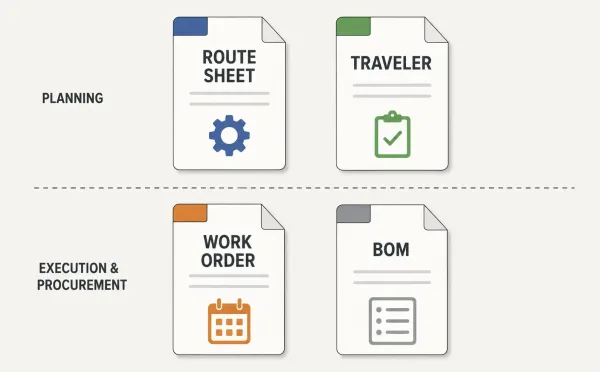
Ein direkter Vergleich der vier wichtigsten Fertigungsdokumente – Arbeitsplan, Laufkarte, Arbeitsauftrag und Stückliste – mit ihren unterschiedlichen Rollen im Produktionsprozess.
Was steht auf einem Arbeitsplan?
Ein Arbeitsplan enthält die Informationen, die ein Werkstattmitarbeiter benötigt, um jede Operation korrekt und konsistent durchzuführen. Typische Felder sind:
| Feld | Was er dem Bediener mitteilt |
|---|---|
| Operationsnummer | Die Reihenfolge – Schritt 1, Schritt 2 und so weiter |
| Operationsbeschreibung | Was bei diesem Schritt zu tun ist (z. B. “Außenkontur laserschneiden”) |
| Arbeitsplatz oder Maschine | Welche Ausrüstung zu verwenden ist (z. B. “Trumpf 3030 Faserlaser”) |
| Rüstzeit | Wie lange die Vorbereitung der Maschine für diesen Auftrag dauert |
| Laufzeit pro Stück | Erwartete Zykluszeit pro Teil |
| Werkzeuge oder Vorrichtungen | Erforderliche Sonderwerkzeuge, Formen oder Aufspannvorrichtungen |
| Prüfpunkt | Ob bei diesem Schritt eine Qualitätskontrolle erforderlich ist und was gemessen werden soll |
| Hinweise | Besondere Anweisungen – Biegerichtung, Faserorientierung, Oberflächenangaben |
Nicht jeder Arbeitsplan enthält alle diese Felder. Ein einfacher Halter kann sechs Zeilen benötigen. Eine komplexe geschweißte Baugruppe mit mehreren Unterkomponenten kann auf zwanzig Zeilen kommen. Der Detaillierungsgrad hängt von der Teilekomplexität und dem Qualitätssystem der Werkstatt ab.
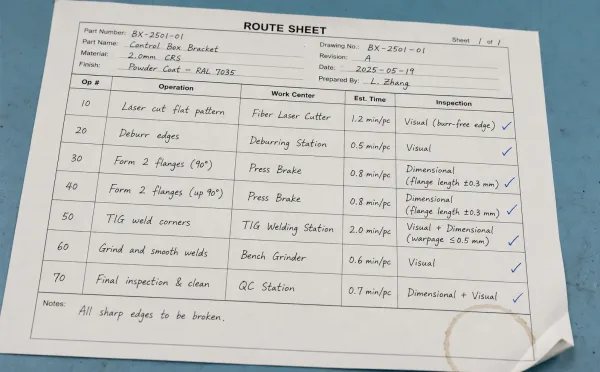
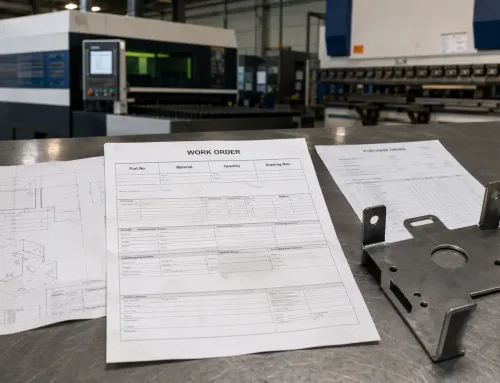
Eine detaillierte Ansicht eines ausgefüllten Arbeitsplans mit den wichtigsten Feldern – Arbeitsfolge, Arbeitsplatzzuordnungen, Zeitangaben und Prüfpunkte – die die Fertigung in der Werkstatt steuern.
Für Einkäufer sind die aussagekräftigsten Felder Arbeitsbeschreibung und Prüfpunkt. Wenn ein Arbeitsplan eine Prüfung zwischen Schweißen und Beschichten auslässt, werden Fehler möglicherweise erst erkannt, wenn das Teil an Ihrer Rampe ankommt.
Ein Arbeitsplan in der Praxis: Ein Blechhalterung durch die Werkstatt verfolgen
Betrachten Sie einen Montagehalter aus 2 mm kaltgewalztem Stahl (CRS), mit lasergeschnittener Kontur, zwei Biegungen, einer Kehlnahtschweißung und einer Pulverbeschichtung. So sieht der zugehörige Arbeitsplan aus:
| Op # | Arbeitsgang | Maschine / Arbeitsplatz | Gesch. Zeit | Prüfung |
|---|---|---|---|---|
| 10 | Flachzuschnitt laserschneiden | Faserlaserschneider | 1,2 min/Teil | Sichtprüfung (gratfreie Kante) |
| 20 | Kanten entgraten | Manueller Entgratungsplatz | 0,5 min/Teil | — |
| 30 | Zwei Flansche bei 90° biegen | Abkantpresse | 0,8 min/Teil | Maßprüfung (Flanschlänge ±0,3 mm) |
| 40 | TIG-Kehlnaht schweißen | TIG-Schweißplatz | 2,0 min/Teil | Sichtprüfung + Maßprüfung (Verzugskontrolle) |
| 50 | Schweißnaht schleifen und glätten | Doppelschleifbock | 0,6 min/Teil | Sichtprüfung |
| 60 | Pulverbeschichtung, RAL 7035 | Pulverbeschichtungslinie | Charge | Beschichtungsdicke (60–80 μm) |
| 70 | Endprüfung | QC-Station | 1.0 min/part | Full dimensional + visual + adhesion |
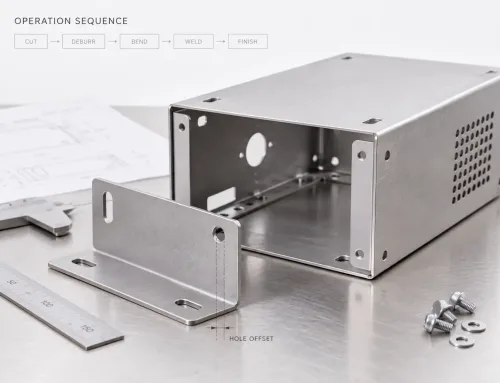
The sequence matters. In kundenspezifische Blechfertigung, laser cutting comes first because the blank must exist before anything can be bent or welded. Bending precedes welding because welding a flat sheet and then bending it would distort the weld. Powder coating comes after all metalworking because heat from welding or grinding would damage the finish.
This is not arbitrary. Each step depends on the geometry and state of the part after the previous step. A route sheet that reorders these operations without a technical reason is a red flag—it suggests the process engineer may not have reviewed the drawing carefully.
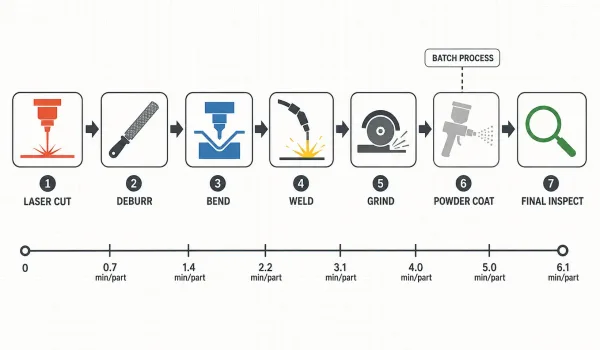
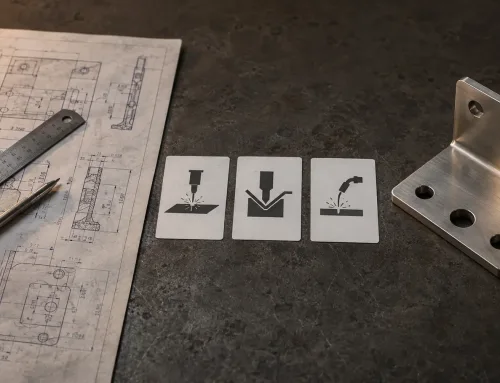
A step-by-step process flow illustrating the seven operations on the route sheet — laser cutting, deburring, bending, welding, grinding, powder coating, and final inspection — for a sheet metal mounting bracket.
Wie der Arbeitsplan Ihr Angebot, Ihre Lieferzeit und Ihre Qualität beeinflusst
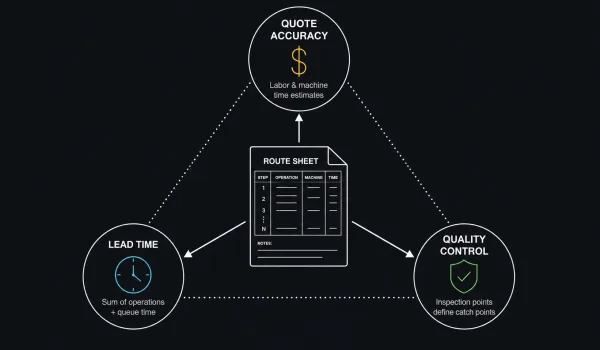
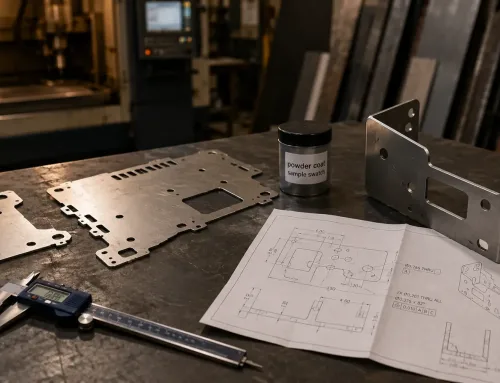
A triangular diagram illustrating the three areas directly shaped by the route sheet — quote accuracy, lead time, and quality control — and how each connects back to the manufacturing plan.
The route sheet is not just a shop-floor instruction. It is the foundation of three things buyers care about.
Quote accuracy. A supplier’s quote is built on estimated labor and machine time. Those estimates come directly from the route sheet. If the route sheet lists eight operations but only six are truly necessary, you are paying for two extra steps. Conversely, if a supplier quotes a suspiciously low price, check whether their route sheet omits operations you expect—like a deburring step or an inspection point.
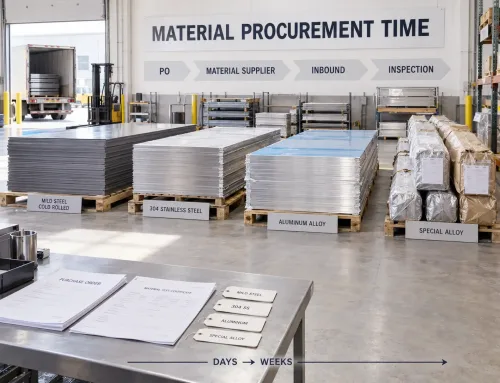
Lead time. The total production time is the sum of all operation times plus queue time between steps. Operations that require outside processing—such as plating, anodizing, or specialty coatings—add three to seven business days to the schedule. A route sheet that sequences an external process between two internal ones creates a bottleneck. Understanding the route sheet helps you ask realistic delivery questions.
Quality control. Inspection points on the route sheet define where and how quality is verified. If a critical dimension is only checked at final inspection, a defect introduced at an earlier step—say, a bend angle out of tolerance—may propagate through welding and coating before anyone catches it. Well-written route sheets place inspection points immediately after the operations most likely to introduce variation.
Was Sie prüfen sollten, wenn Sie einen Arbeitsplan erhalten
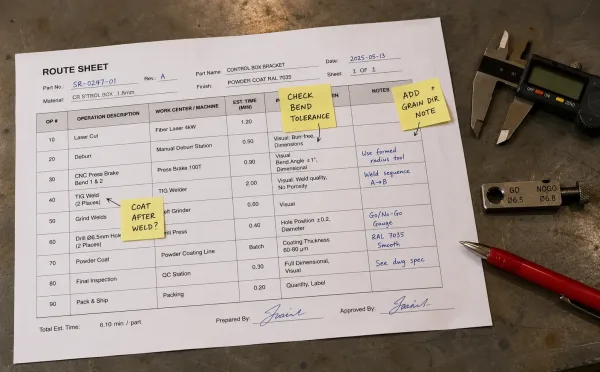
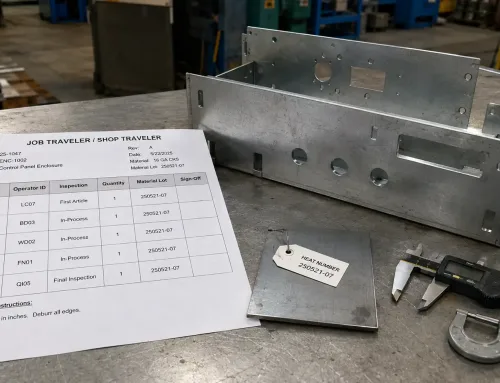
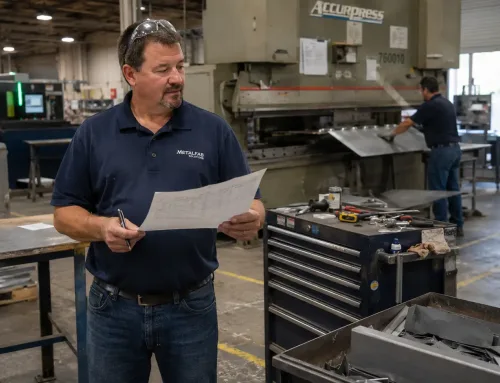
A route sheet being reviewed before production, with sticky-note callouts marking critical areas to verify — inspection checkpoints, operation sequencing, and missing special instructions.
If your supplier shares the route sheet, or if you request one during the quoting stage, here is what to look for:
- Operation sequence makes sense. Each step should logically follow from the previous one. Ask yourself: could this operation have been done earlier without causing a problem? Could it be combined with another step?
- Inspection points cover critical features. If your sheet metal fabrication drawing calls out a tight tolerance on a bent dimension, there should be an inspection step immediately after bending—not just at final inspection.
- Surface treatment is sequenced after all metalwork. Coating, plating, or anodizing should come after cutting, bending, welding, and grinding. If the route sheet shows coating before welding, something is wrong.
- Operation count matches part complexity. A flat laser-cut bracket with no bends and no welds should not have ten operations. Extra steps may indicate inefficiency—or that the supplier is padding the quote.
- Special requirements are noted. Grain direction, bend orientation, masking for selective coating, and thread protection during surface treatment should appear in the notes column. If they are missing, the floor operator has to guess.
- Outside processes are identified. Any step that requires sending the part to a subcontractor—such as zinc plating or heat treatment—should be clearly marked with an estimated turnaround time.
A route sheet is a communication tool. When it is clear and complete, production runs smoothly. When it is vague or missing details, the shop floor fills in the gaps—and the results may not match your expectations.
FAQ
Understanding how your parts are built gives you better control over cost, schedule, and quality. If you would like a route sheet summary included with your next quote from SR-MFG, or if you want our engineering team to review a route sheet for an existing project, Kontaktieren Sie uns to get started.