
WWenn Sie eine Zeichnung und eine Bestellung an einen Blechhersteller senden, muss jemand in der Werkstatt eine grundlegende Frage beantworten: Was genau stellen wir her, und wie? Das Dokument, das diese Frage beantwortet — dasjenige, das Ihre Designabsicht in eine Reihe von Produktionsanweisungen übersetzt — ist der Arbeitsauftrag. In der kundenspezifischen Fertigung ist er der Ausgangspunkt für alles, was in der Werkstatt geschieht.
Dennoch behandeln die meisten Online-Definitionen “Arbeitsauftrag” als Instandhaltungsbegriff — eine Anforderung, eine defekte Maschine zu reparieren oder ein Gebäude zu warten. Das ist eine Bedeutung, aber nicht die, die zählt, wenn Sie kundenspezifische Teile kaufen. In der Fertigung ist ein Arbeitsauftrag etwas anderes: Er ist der Produktionsvertrag zwischen dem Käufer und der Fabrik.
Dieser Glossareintrag erklärt, was ein Arbeitsauftrag im Fertigungskontext bedeutet, welche Informationen er enthält, wie er sich von verwandten Dokumenten wie Bestellungen und Laufkarten unterscheidet und warum seine Vollständigkeit direkt die Qualität, die Kosten und die Lieferung Ihrer Teile beeinflusst.
Was ist ein Arbeitsauftrag in der Fertigung?
Ein Arbeitsauftrag — manchmal auch Produktionsauftrag, Fertigungsauftrag oder Werkstattauftrag genannt — ist ein internes Dokument, das von einem Hersteller ausgestellt wird, um einen Produktionslauf zu genehmigen und zu definieren. Er teilt der Werkstatt mit, was herzustellen ist, in welcher Menge, aus welchem Material, nach welcher Spezifikation und bis wann.
Im Instandhaltungskontext weist ein Arbeitsauftrag einem Techniker die Reparatur eines Geräts zu. Im Fertigungskontext weist er dem Produktionsteam die Fertigung eines Teils oder einer Baugruppe zu. Der Begriff ist derselbe; die Funktion ist völlig anders.
Ein Fertigungsarbeitsauftrag wird erstellt, nachdem der Käufer eine Bestellung aufgegeben hat (typischerweise bestätigt durch eine Bestellung) und bevor die Produktion beginnt. Er ist das Dokument, das die kommerzielle Vereinbarung — was der Käufer möchte — und die Werkstattrealität — was die Operatoren tatsächlich bauen — überbrückt. Der Arbeitsauftrag bezieht seinen Inhalt aus der Zeichnung des Käufers, der Bestellung, dem Angebot und allen technischen Klärungen, die während des Angebotsprozesses ausgetauscht wurden.
In einem typischen Blechfertigungs-Workflow, sieht die Abfolge wie folgt aus:
- Der Käufer sendet eine Angebotsanfrage (RFQ) mit Zeichnungen.
- Der Hersteller bietet Preis und Lieferzeit an.
- Der Käufer erteilt eine Bestellung.
- Der Hersteller erstellt einen Arbeitsauftrag auf Basis der Bestellung und der Zeichnung.
- Der Arbeitsauftrag steuert Produktion, Prüfung und Versand.
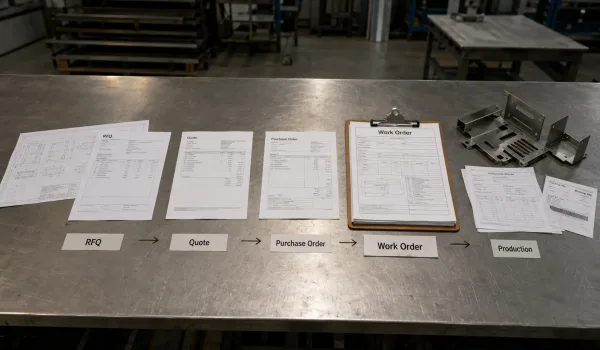
Ein Fertigungs-Workflow, der zeigt, wie eine Angebotsanfrage und eine Bestellung zu einem Arbeitsauftrag führen, der die Produktion steuert.
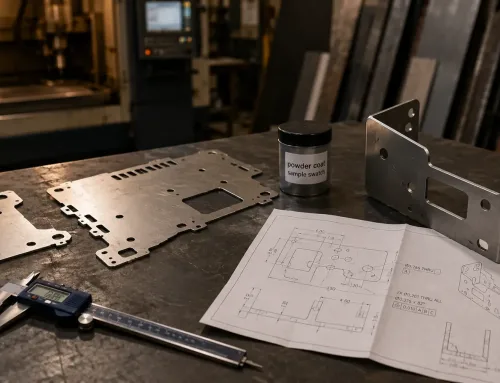
Der Arbeitsauftrag ist nicht die Zeichnung selbst — die Zeichnung definiert die Geometrie und Toleranzen. Der Arbeitsauftrag ist die Produktionsanweisung, die auf die Zeichnung verweist und die Informationen bereitstellt, die für die Fertigungsprozessplanungbenötigt werden: welche Maschine zu verwenden ist, welche Reihenfolge einzuhalten ist, wie viele herzustellen sind und wann zu liefern ist.
Welche Informationen enthält ein Fertigungsarbeitsauftrag?
Ein Arbeitsauftrag ist nur so nützlich wie die Informationen, die er enthält. Ein vager oder unvollständiger Arbeitsauftrag zwingt Operatoren zu Annahmen — und Annahmen in der Werkstatt führen zu Ausschuss, Nacharbeit und verpassten Lieferterminen.
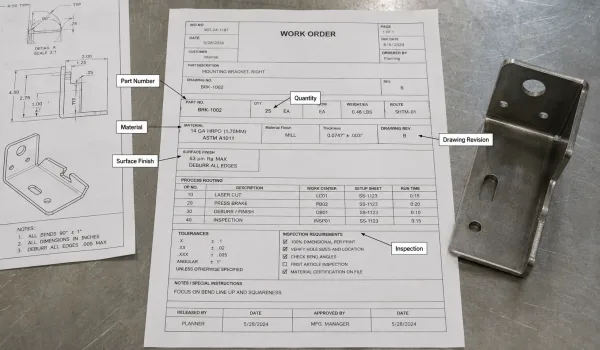
Ein Fertigungsarbeitsauftrag, der die wichtigsten Informationen für Material, Menge, Zeichnungsrevision, Oberfläche, Lieferung und Prüfung hervorhebt.
Die folgende Tabelle listet die wichtigsten Felder auf, die auf einem typischen Fertigungsarbeitsauftrag zu finden sind, mit Hinweisen, warum jedes einzelne wichtig ist:
| Feld | What It Specifies | Warum es wichtig ist |
|---|---|---|
| Job or Part Number | Unique identifier for the production run | Tracks the order through every department; prevents mix-ups between similar parts |
| Part Name and Description | What the part is (e.g., “bracket,” “enclosure top cover”) | Gives operators a quick reference; prevents wrong-part production |
| Menge | How many units to produce | Determines material procurement, setup amortization, and scheduling |
| Werkstoffspezifikation | Material type, grade, and thickness (e.g., “CRS SPCC, 1.5 mm”) | Wrong material means wrong mechanical properties, wrong weight, and potential failure in the field |
| Maße und Toleranzen | Reference to the engineering drawing, plus any critical dimensions | The drawing is the authority; the work order highlights which dimensions are critical for inspection |
| Surface Finish Requirement | Paint, powder coat, anodizing, plating, or bare finish | Affects post-processing steps, cost, and lead time; missing this means the part may ship unfinished |
| Bend Information | Number of bends, angle, radius, direction | Essential for sheet metal parts; wrong bend sequence or angle means dimensional failure |
| Delivery Date | When the finished parts must ship | Drives production scheduling; late delivery often starts with a missing or unrealistic date on the work order |
| Reference Drawing Number and Revision | Which drawing version to use | Prevents production from an outdated revision — a common and costly error |
| Quality or Inspection Requirements | Functional test, visual inspection criteria, sampling plan | Tells QC what to check and how strictly; without this, inspection defaults to the operator’s judgment |
Not every work order includes every field. The level of detail depends on the complexity of the part and the manufacturer’s internal systems. But the principle holds: the more complete the work order, the less the shop floor has to guess.
Arten von Arbeitsaufträgen in der Fertigung
Manufacturing companies use different types of work orders depending on the nature of the job. The most common types in custom part fabrication include:
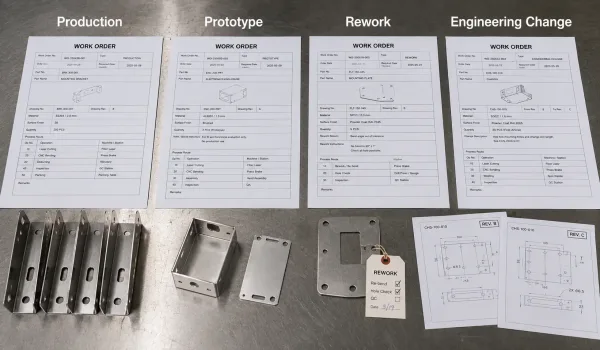
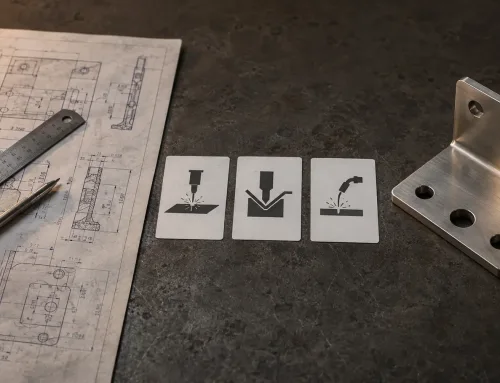
Four manufacturing work order types used for production, prototypes, rework, and engineering changes.
Production work order. The standard type — issued for a confirmed order of parts to be manufactured according to the buyer’s drawing and specifications. This is the work order you are most likely to encounter when sourcing kundenspezifische Blechfertigung or machined parts.
Prototype or sample work order. Issued for small quantities — often 1 to 10 pieces — intended for design validation, testing, or first-article approval. Prototype work orders may skip some production steps (such as surface finishing) or use alternative processes (such as laser cutting instead of stamping) to save time and tooling cost.
Rework work order. Issued when finished parts fail inspection or when the buyer requests a modification after production has started. A rework work order specifies what went wrong, what corrective action to take, and whether the rework is at the manufacturer’s expense or the buyer’s.
Engineering change work order. Issued when the buyer revises the drawing after the original work order has been released. This type of work order documents the change — what is different, which revision is now current, and whether existing parts are acceptable or must be scrapped.
Each type serves a distinct purpose, but they all share the same core function: to define what the shop floor must produce and under what conditions.
Arbeitsauftrag vs. verwandte Dokumente: Was ist der Unterschied?
Several documents circulate during a manufacturing order, and their names are sometimes used interchangeably. This creates confusion — especially for buyers who are new to working with overseas or custom manufacturers. Here is how the key documents differ:
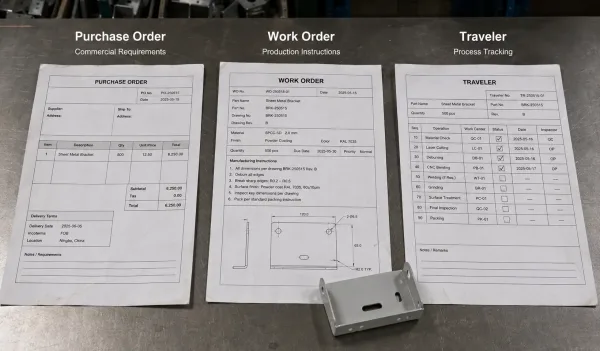
A comparison showing the purchase order as the commercial document, the work order as the production instruction, and the traveler as the production tracking document.
Work order vs. purchase order. A purchase order (PO) is a commercial document issued by the buyer. It authorizes the purchase, specifies quantity, price, delivery terms, and payment conditions. A work order is an internal production document issued by the manufacturer. It translates the PO’s commercial requirements into shop-floor instructions. You can think of the PO as the contract and the work order as the execution plan.
Work order vs. work request. A work request — sometimes called a maintenance request or a job request — is a proposal or ask. It has not yet been approved, scheduled, or resourced. A work order is the approved, scheduled, and authorized version. In manufacturing, the buyer’s purchase order effectively functions as the “request,” and the manufacturer’s work order is the response.
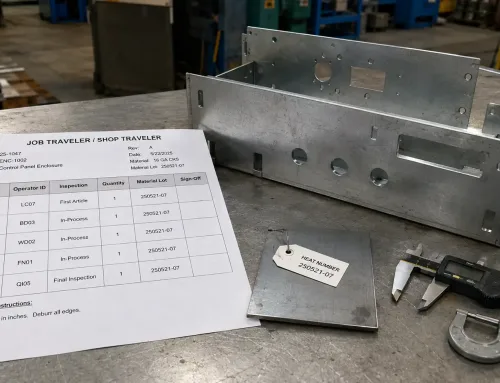
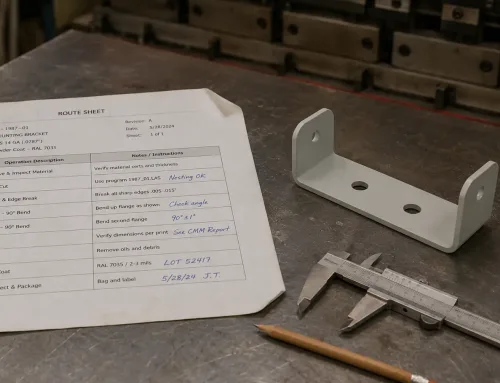
Work order vs. traveler (route sheet). A traveler — also called a Fertigungsarbeitsplan or routing sheet — is a document that follows the part through each production step. It records what was done, by whom, at each station. The work order authorizes the job; the traveler tracks its execution. The work order says “make 200 brackets from 1.5 mm CRS, powder coat black, deliver by September 15.” The traveler says “Step 1: laser cut — done by Operator A on August 28. Step 2: bend — done by Operator B on August 29.” They are complementary, not interchangeable.
Understanding these distinctions helps you communicate more precisely with your manufacturer. If you ask about the “work order status,” you are asking whether production has started. If you ask about the “traveler,” you are asking where the parts are in the process.
Warum die Vollständigkeit des Arbeitsauftrags für Käufer wichtig ist
A work order with missing or ambiguous information does not stop the shop floor — it forces the shop floor to guess. And guesses in manufacturing are expensive.
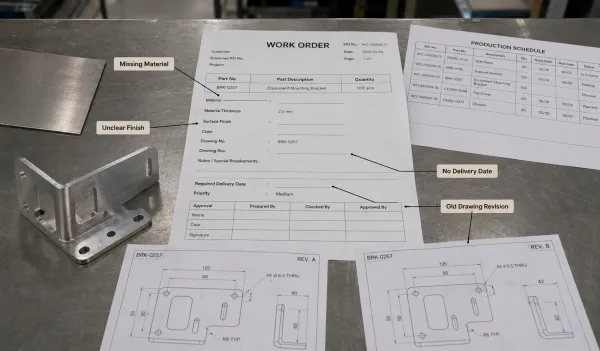
An incomplete manufacturing work order showing how missing material, finish, delivery date, and drawing revision information creates production risk.
Here is what happens when key fields are left blank or vague:
- Missing material specification. The operator picks the most common material in stock — which may not be the grade or thickness you need. The parts pass inspection but fail in the field because the mechanical properties are wrong.
- Unclear surface finish requirement. The parts are fabricated and delivered bare — no paint, no powder coat, no plating. You receive them, realize they are unfinished, and send them back. That is two to four weeks of lead time lost.
- No delivery date. Without a committed date, the work order sits in the queue behind other jobs. Your parts ship when the manufacturer gets to them, not when you need them.
- Missing or outdated drawing revision. The shop floor works from Rev B while you approved Rev C. The parts are dimensionally correct — for the wrong revision.
None of these failures are caused by poor manufacturing quality. They are caused by incomplete information at the work order stage. As a buyer, you cannot directly control how the manufacturer creates their internal work orders. But you can control the information supplied in your sheet metal RFQ, drawings, and purchase orders — because that is where the work order gets its information.
The most effective thing you can do is ensure your drawing specifies every critical parameter — material, thickness, tolerances, surface finish, bend details, and inspection requirements — and that your purchase order references the correct drawing revision. A complete drawing and a clear PO give the manufacturer everything they need to create a complete work order.
FAQs
A work order is the manufacturing process’s starting point. But it is only as reliable as the information that goes into it. For buyers of custom parts, the most practical takeaway is simple: make your drawings and purchase orders complete enough that the manufacturer does not have to guess. The clearer your input, the more predictable your output.