
Specifying Epoxid-Grundierung auf einem Bauteil aus Kohlenstoffstahl-Blech klingt unkompliziert — eine Zeile zur Zeichnung hinzufügen, zur Angebotserstellung versenden und weitermachen. In der Praxis trägt diese einzelne Zeile mehr Gewicht, als die meisten Ingenieure erwarten. Das von Ihnen spezifizierte Beschichtungssystem beeinflusst welche Fertigungsschritte zuerst kommen, ob das Bauteil nach der Grundierung geschweißt werden kann, wie sich Biegeradien unter Belastung verhalten und ob die endgültigen Montagemaße noch innerhalb der Toleranz liegen. Bei einem einfachen Halter mögen dies geringfügige Bedenken sein. Bei einem eng tolerierten Gehäuse mit Schweißnähten und Presssitz-Komponenten kann die Missachtung dieser Faktoren bedeuten Nacharbeit, verzögerte Lieferung oder ein Bauteil, das innerhalb von Monaten nach der Installation korrodiert aussieht.
Dieser Leitfaden erklärt, was Epoxid-Grundierung auf Kohlenstoffstahl-Blech bewirkt, wie man sie korrekt spezifiziert und was in der Fertigung passiert, wenn man es tut.
Warum Kohlenstoffstahl-Blech eine Grundierung benötigt
Kohlenstoffstahl korrodiert. Im Gegensatz zu Edelstahl, der eine passive Chromoxidschicht bildet, die weiterer Oxidation widersteht, besitzt Kohlenstoffstahl keinen Selbstschutzmechanismus. Bei Exposition gegenüber Feuchtigkeit und Sauerstoff — selbst in einem Lager oder während des Inlandsversands — entwickelt blanker Kohlenstoffstahl innerhalb von Tagen Oberflächenrost. In aggressiven Umgebungen (küstennah, industriell oder bei hoher Luftfeuchtigkeit) schreitet die Korrosion schneller voran und kann sowohl das Erscheinungsbild als auch die strukturelle Integrität beeinträchtigen.
Bei Blechbauteilen wird das Risiko durch die Oberfläche verstärkt. Eine flache Platte oder ein geformter Halter setzt eine große Fläche ungeschützten Metalls der Umgebung aus. Kanten, die durch Laser oder Stanzen geschnitten wurden, sind besonders anfällig , da die wärmebeeinflusste Zone jeglichen Walzzunder stört, der andernfalls einen marginalen Schutz bieten könnte.
Eine Grundierung dient als erste Schicht eines Beschichtungssystems. Ihre Aufgabe ist zweifach: an das Stahlsubstrat binden und eine korrosionsbeständige Basis für nachfolgende Schichten bieten. Ohne sie wird selbst eine hochwertige Deckbeschichtung vorzeitig versagen, da ihr eine stabile Haftungsgrundlage fehlt.
Was Epoxid-Grundierung auf Kohlenstoffstahl tatsächlich bewirkt
Epoxid-Grundierung ist eine Zweikomponenten-Beschichtung (2K) — eine Harzbasis, die vor der Anwendung mit einem Härter (Amin- oder Polyamid-Härtungsmittel) gemischt wird. Nach dem Mischen vernetzen die Komponenten und bilden einen dichten, chemisch beständigen Film. Diese Vernetzung verleiht Epoxid seinen Vorteil gegenüber Einkomponenten-Grundierungen: höhere Haftfestigkeit, bessere Barrierewirkung und größere Beständigkeit gegen Feuchtigkeit und Chemikalien.
Auf Kohlenstoffstahl bietet Epoxid-Grundierung zwei Kernfunktionen:
- Haftungsförderung. Der Epoxidfilm bindet mechanisch und chemisch an die strahlgereinigte Stahloberfläche und schafft eine Grundlage, an der nachfolgende Schichten (Epoxid-Zwischenschicht, Polyurethan-Deckbeschichtung) ohne Delaminierung haften können.
- Barriere-Schutz. Der ausgehärtete Film wirkt als physikalische Barriere und blockiert Feuchtigkeit, Sauerstoff und korrosive Ionen vom Eindringen zum Stahlsubstrat. Er bietet keinen kathodischen Schutz (im Gegensatz zu zinkreichen Grundierungen), aber für C2–C4-Umgebungen gemäß ISO 12944, ist Barriere-Schutz allein oft ausreichend.
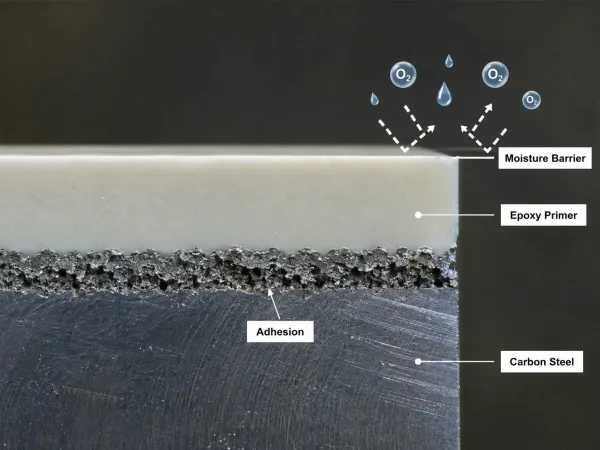
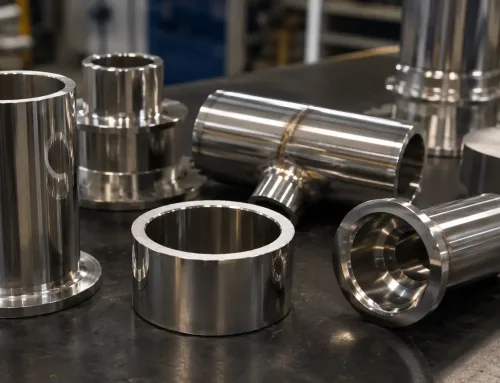
Epoxid-Grundierung bindet an vorbereiteten Kohlenstoffstahl und blockiert Feuchtigkeit und korrosive Verunreinigungen.
Eine Standard-Epoxid-Grundierung wird mit einer Trockenfilmdicke (DFT) von 50–80 µm pro Schicht. aufgetragen. Für die meisten Kohlenstoffstahl-Blechbauteile in Innenräumen oder mild korrosiven Umgebungen ist eine einzelne Grundierungsschicht gefolgt von einer Deckbeschichtung ausreichend. Für Außen- oder Industrieexposition ist ein Dreischichtsystem — Epoxid-Grundierung, Epoxid-Zwischenschicht, Polyurethan-Deckbeschichtung — üblicher, wobei die Gesamt-DFT des Systems 200–300 µm.
erreicht. Eine Unterscheidung ist erwähnenswert: 2K-Epoxid-Grundierung vs. Einkomponenten-Epoxid-Grundierung (1K). Ein 2K-System härtet durch chemische Vernetzung aus und liefert überlegene Leistung. Ein 1K-System härtet durch Feuchtigkeitsaufnahme oder Lösungsmittelverdunstung aus und ist im Allgemeinen auf Leichtbau- oder Instandhaltungsanwendungen beschränkt. Für die Neufertigung von Kohlenstoffstahl-Blechbauteilen ist, 2K-Epoxid die Standardspezifikation.
Oberflächenvorbereitung — Der Schritt, der darüber entscheidet, ob die Beschichtung funktioniert
Die Oberflächenvorbereitung ist der einzelne wichtigste Faktor für die Beschichtungsleistung. Eine gut spezifizierte Epoxid-Grundierung, die auf schlecht vorbereiteten Stahl aufgetragen wird, versagt innerhalb von Monaten. Der Konsens der Beschichtungsindustrie — gestützt auf jahrzehntelange Felddaten — ist, dass die Oberflächenvorbereitung etwa 60–80 % der Nutzungsdauer eines Beschichtungssystems ausmacht.
Für Kohlenstoffstahl-Blech ist der Mindeststandard der Strahlvorbereitung der Oberfläche für Epoxid-Grundierung Sa 2½ gemäß ISO 8501-1 (entspricht SSPC-SP10 / NACE Nr. 2 Near-White Blast). Dies entfernt Walzzunder, Rost, alte Beschichtungen und Oberflächenverunreinigungen und hinterlässt ein sauberes, winkliges Oberflächenprofil, an dem die Grundierung verankern kann.
Two additional factors matter:
- Surface profile (anchor pattern). The blast-cleaned surface should have a surface roughness (Rz) of 40–70 µm (confirm against the primer product TDS). Too smooth, and the primer cannot grip. Too rough, and peaks may protrude through the film, creating weak spots where corrosion can initiate.
- Surface cleanliness. Before blasting, the steel must be free of oil, grease, and soluble salts. Solvent or detergent cleaning (per ISO 8504-1) should precede abrasive blasting. Contamination left on the surface will cause adhesion failure regardless of blast quality.
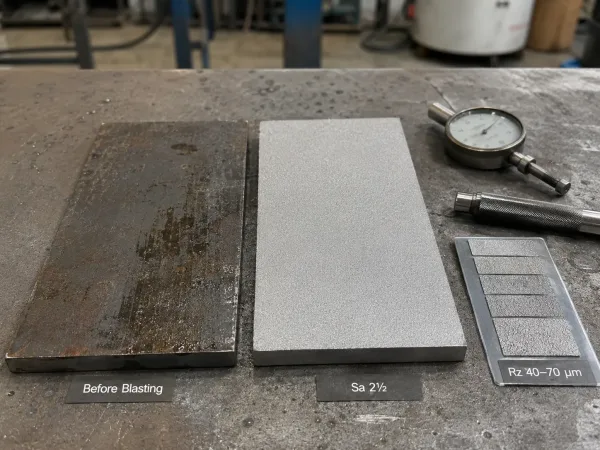
Proper abrasive blasting creates the clean and profiled surface required for reliable epoxy-primer adhesion.
Hot-rolled vs. cold-rolled carbon steel presents a practical difference. Hot-rolled sheet carries a layer of mill scale (iron oxide from the rolling process) that must be fully removed by blasting. Kaltgewalztes Kohlenstoffstahlblech is typically smoother and free of mill scale, but may carry rolling oils that require degreasing before any surface treatment.In both cases, the goal is the same: a clean, properly profiled surface ready for primer.
After blasting, the surface should be primed as soon as possible — ideally within the same shift. Flash rust can begin to form on freshly blasted carbon steel within hours in humid conditions, and re-blasting adds cost and delays.
Epoxy Primer vs Other Primer Types for Carbon Steel
Epoxy primer is the most common choice for carbon steel sheet metal in industrial applications, but it is not the only option. The table below compares four primer types across the factors that matter for fabricated parts:
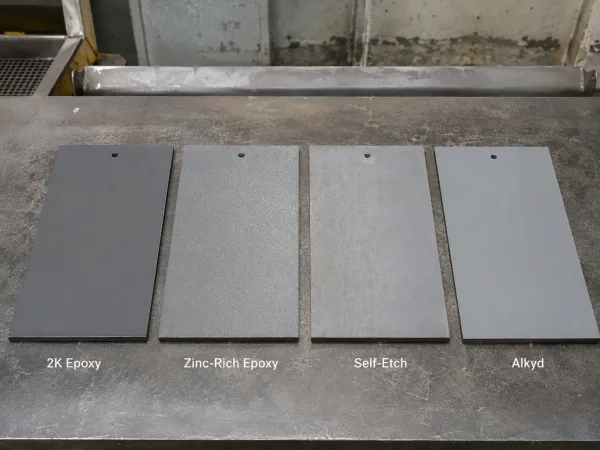
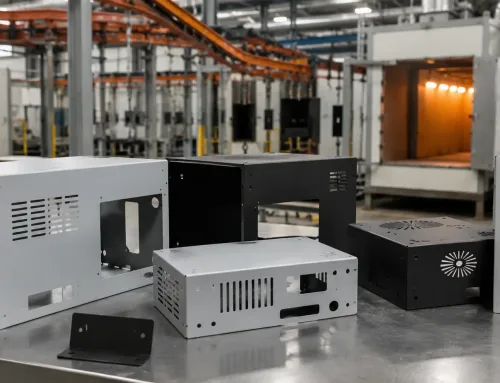
Different primer systems provide different levels of adhesion, corrosion protection, and environmental resistance.
| Faktor | Epoxy Primer (2K) | Zinc-Rich Epoxy | Self-Etch / Wash Primer | Alkyd Primer |
|---|---|---|---|---|
| Primary function | Barrier + adhesion | Galvanic + barrier | Chemical etch + adhesion | Barrier (basic) |
| Corrosion protection | Good (C2–C4) | Excellent (C4–CX) | Light (C1–C2) | Light (C2) |
| Chemical resistance | Hoch | Hoch | Niedrig | Niedrig |
| Typical DFT | 50–80 µm | 60–80 µm | 8–15 µm | 40–60 µm |
| Am besten für | General industrial carbon steel | Heavy-duty outdoor, marine, buried | Light-gauge, non-structural | Budget, indoor, light exposure |
| Einschränkung | Not for immersion or CX without intermediate coat | Higher cost; topcoat required | Insufficient for structural carbon steel | Poor chemical resistance; slow cure |
For most carbon steel sheet metal parts — brackets, enclosures, panels, frames, and structural components in C2–C4 environments — a standard 2K epoxy primer is the appropriate specification. Zinc-rich epoxy is worth specifying when the parts will be exposed to marine, coastal, or heavy industrial atmospheres (C5 or higher), or when the design life exceeds 15 years with limited maintenance access.
Self-etch primers and alkyd primers are generally not suitable for fabricated carbon steel sheet metal. Self-etch primers are designed for thin-gauge or non-structural substrates and do not provide sufficient barrier protection for industrial use. Alkyd primers cure slowly, offer limited chemical resistance, and are more common in architectural or light-duty applications.
How Specifying Epoxy Primer Affects Sheet Metal Manufacturing
This is where many engineers and buyers discover that a coating specification is not just a surface treatment decision — it is a manufacturing sequence decision. Specifying epoxy primer on a drawing changes how the shop floor plans, produces, and inspects the part.
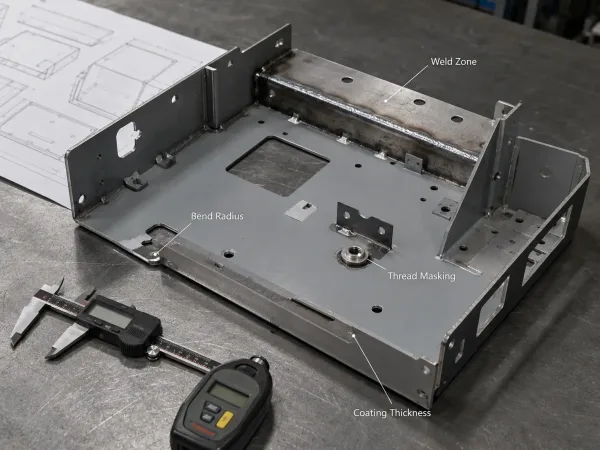
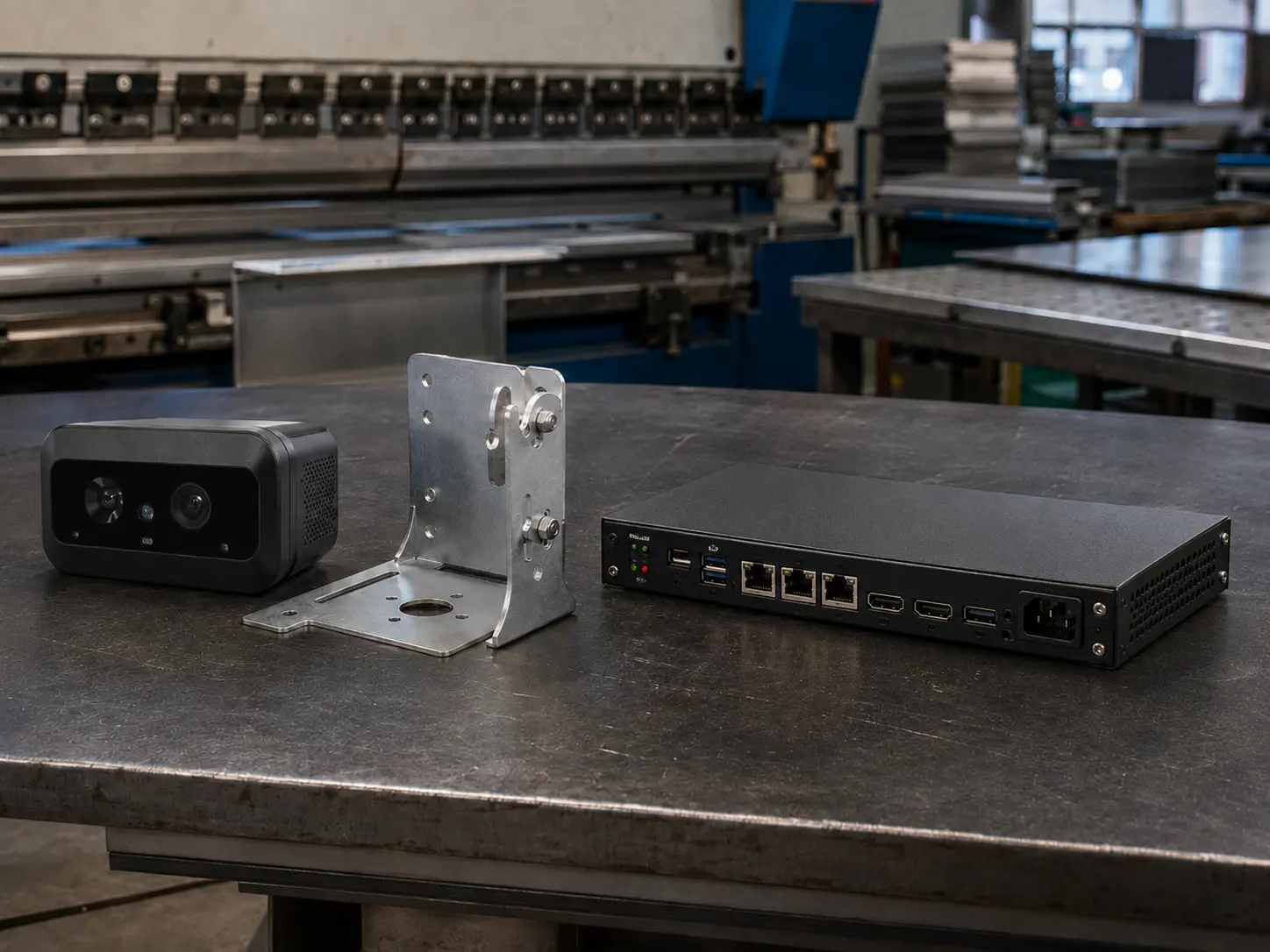
Epoxy primer affects welding zones, bend integrity, threaded features, and finished part dimensions.
Welding zones must remain uncoated
Epoxy primer burns at welding temperatures (typically above 250–300 °C). Applying primer before welding creates three problems: toxic fumes for the welder, porosity and inclusions in the weld joint, and contamination of the weld pool. For parts that require welding, the standard practice is to mask or leave unprimed a buffer zone of at least 50 mm around each weld seam. This means the coating specification must account for post-weld touch-up — and the buyer must accept that the weld zone will have a different surface finish than the primed area unless a full re-coat is performed after welding.
Bend radii affect coating integrity
When a primed sheet metal blank is bent, the coating on the outer radius stretches. If the epoxy primer’s flexibility is insufficient for the bend ratio (inner radius / material thickness), the film will crack or delaminate at the fold. For tight bends on thin sheet (e.g., 1 mm CRS with 0.5 mm inner radius), this risk is real. The solution is either to specify a primer with documented flexibility (check the TDS for mandrel bend test results), or to apply primer after forming — which changes the manufacturing sequence and may increase cost.
Film thickness adds to part dimensions
A coat of epoxy primer at 50–80 µm DFT adds that thickness to each surface. On a sheet metal part with two primed faces, the total dimensional increase is 100–160 µm (0.10–0.16 mm). For most parts, this is negligible. For press-fit interfaces, gasket surfaces, or assemblies with tight clearance requirements, it may not be. If a part has a critical mating dimension, the sheet metal surface requirements on the drawing should specify whether the tolerance applies before or after coating.
Threading and fastener compatibility
Primer inside a threaded hole can interfere with fastener engagement, increasing torque and potentially causing thread damage. The standard practice is to mask or ream threaded holes after priming, or to apply primer only to external surfaces. This should be noted on the drawing if it affects function.
Lead time and cost impact
Adding a primer coat to a sheet metal order is not a zero-cost, zero-time operation. The typical sequence — surface preparation (blasting) → primer application → flash-off / cure → inspection — adds 3–5 working days to the lead time for in-house coating, or longer if the coating must be outsourced to a specialist facility. For low-volume projects, the setup and minimum charge for a coating batch can make the per-part cost significant. Buyers should confirm the coating step when reviewing quotes, not after the order is placed.
How to Specify Epoxy Primer on Your Drawings and RFQs
A vague coating callout — “prime with epoxy” or “apply rust-resistant primer” — leaves too much to the manufacturer’s interpretation. The result is often the minimum-cost, minimum-performance option applied at the thinnest acceptable thickness. To get the coating system you need, use a drawing and RFQ checklist for sheet metal fabrication to specify five elements:
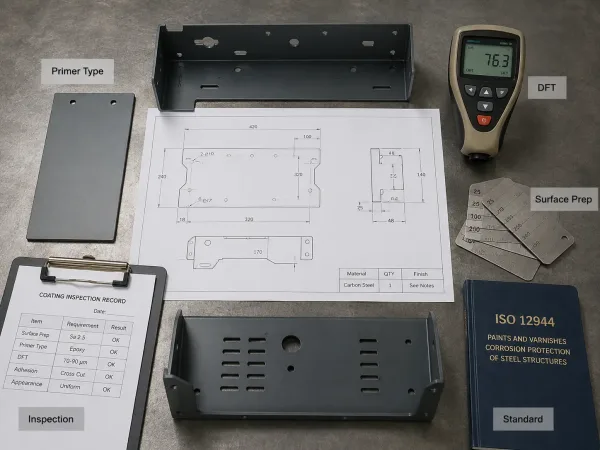
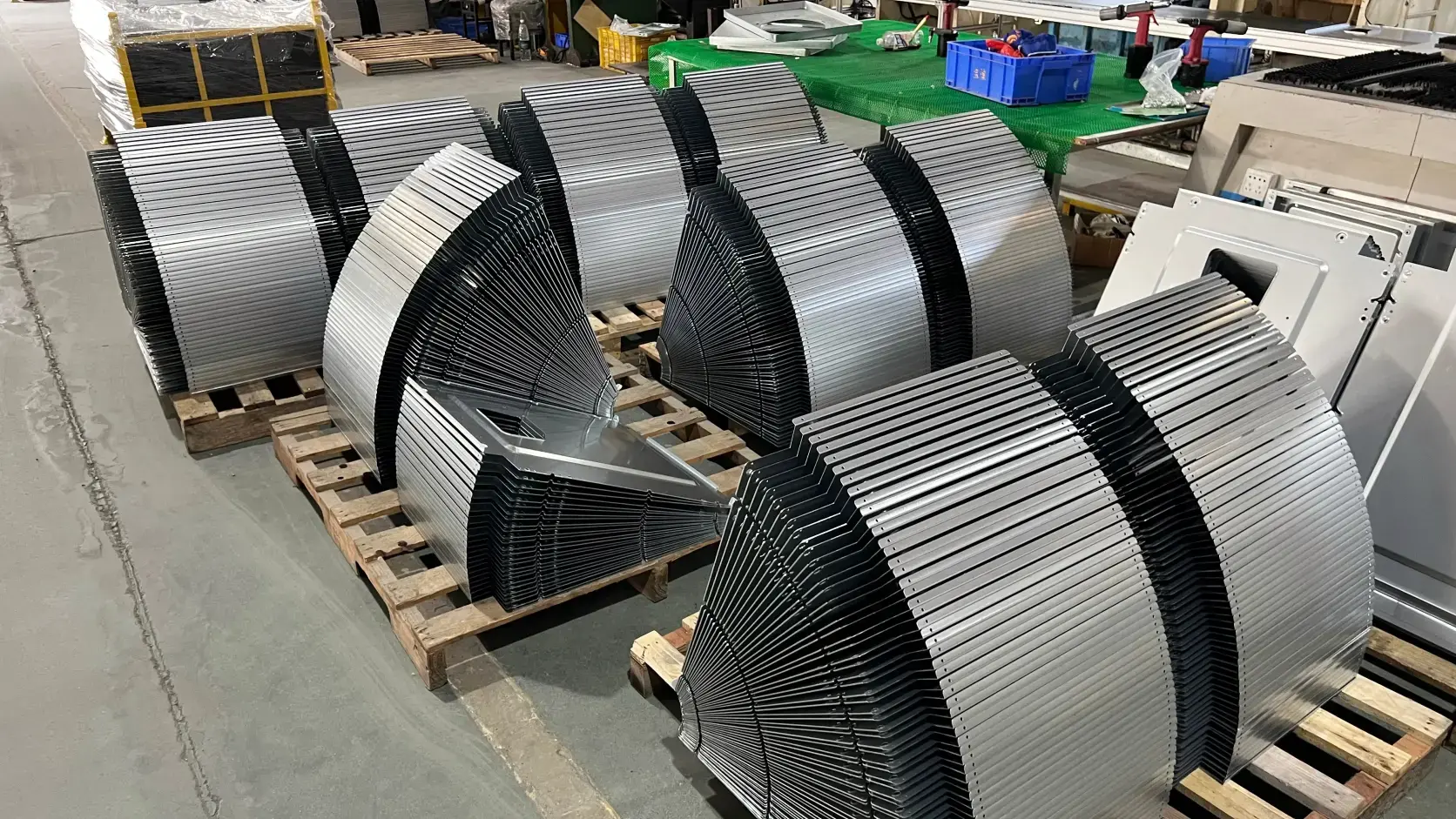
A complete coating specification defines primer type, DFT, surface preparation, inspection, and reference standard.
1. Coating type and system. State the primer chemistry, number of coats, and (if applicable) the full system. Example: “2K epoxy primer per ISO 12944-5, followed by polyurethane topcoat for C4 environment.”
2. Dry film thickness (DFT). Specify the acceptable range per coat. Example: “Epoxy primer: 50–75 µm DFT per coat.” If a total system DFT is required, state it: “Total system DFT: 200–250 µm.”
3. Surface preparation standard. Reference the blast-cleanliness standard and surface profile. Example: “Abrasive blast to Sa 2½ per ISO 8501-1, surface profile Rz 40–70 µm.”
4. Inspection and acceptance criteria. Define how the coating will be verified. Common methods include:
- DFT measurement per ISO 2808 (magnetic gauge for steel substrates)
- Adhesion test per ISO 2409 (cross-cut test, rating ≤ 1 for acceptable adhesion)
- Visual inspection for runs, sags, pinholes, and holidays
5. Reference standard. Cite the governing standard for the coating system. ISO 12944 is the most widely recognized international standard for corrosion protection of steel structures by protective paint systems. SSPC and NACE standards are common in North American specifications.
A complete coating callout on a drawing might read:
“2K epoxy primer, 50–75 µm DFT, applied over Sa 2½ blast-cleaned surface (Rz 40–70 µm) per ISO 8501-1. DFT verified per ISO 2808. Adhesion per ISO 2409, rating ≤ 1. Coating system per ISO 12944-5, C4 environment, high durability.”
This level of detail removes ambiguity and ensures the manufacturer quotes and produces to the correct standard.
Wichtige Erkenntnisse
- Carbon steel corrodes without protection. Epoxy primer is the standard first layer of a coating system for fabricated carbon steel sheet metal parts in C2–C4 environments.
- Surface preparation determines coating life. Specify abrasive blasting to Sa 2½ (ISO 8501-1) with a surface profile of Rz 40–70 µm. No amount of high-quality primer compensates for poor prep.
- 2K epoxy is the baseline for new fabrication. Single-component primers, self-etch primers, and alkyd primers are not appropriate substitutes for structural carbon steel parts.
- Coating specifications are manufacturing specifications. Specifying epoxy primer affects the production sequence — it determines what gets welded first, how bends behave, whether threads need reaming, and how many days the order takes to ship.
- Spell it out on the drawing. A complete callout — coating type, DFT, surface prep, inspection method, reference standard — prevents misinterpretation and ensures the part arrives coated to your actual requirements, not the manufacturer’s default.